I served eight years on the European Solidarity Committee. It is a very important committee in the European Mathematical Society. It seems worthwhile summarizing here the mission of the committee, as it is not widely known. In a nutshell: it focuses on less developed, less wealthy European countries and mathematicians.
The mission of the European Solidarity Committee is the following:
provides support to European mathematicians in need;
supports early-career researchers and colleagues with limited resources for mathematics;
focuses on countries or individuals affected by economic hardship, political instability, or conflict;
offers assistance via grants and travel support;
aims to promote equity and inclusion in mathematical communities.
In June 2025, I participated in the second Balkan Mathematics Conference in Thessaloniki and gave a talk jointly with Özlem Beyarslan on the European Solidarity Committee, with the goal of advertising the activities of the committee in Balkan countries. (The first Balkan Mathematics Conference was held in Romania two years ago.)
I was very happy that among the 75 participants there were mathematicians from Greece, Turkey, Serbia, Slovenia, India, Austria, Croatia, USA, Poland, Oman, UK, Germany, Morocco, Kuwait, Nigeria, China, Bosnia and Herzegovina, Qatar, Hungary, Canada, Australia, Ireland and Denmark. A really richly varied audience!
Unfortunately, Albania, Bulgaria, Kosovo, Montenegro and North Macedonia were not represented.
I hope that as a result of this talk the Balkan countries will take advantage of the possibilities offered by the European Solidarity Committee.
The talk focused on the advantages of using the committee for mathematicians in less developed countries. We have noticed in our work that these less-developed countries in the Balkans do not apply for any support to the European Solidarity Committee, perhaps because they are not aware about its existence. The problem in those countries is that there are only a few individual members, partly because for people there it is sometimes even complicated to pay the local Mathematical Society fee, let alone the EMS fee. This part of Europe is still in a different situation from Western countries. There are also countries where the local Mathematical Society is not a member of the EMS. As an example, in Serbia there are nine public and ten private universities, and also some colleges. It is rather likely that the information about the European Solidarity Committee does not reach those places.
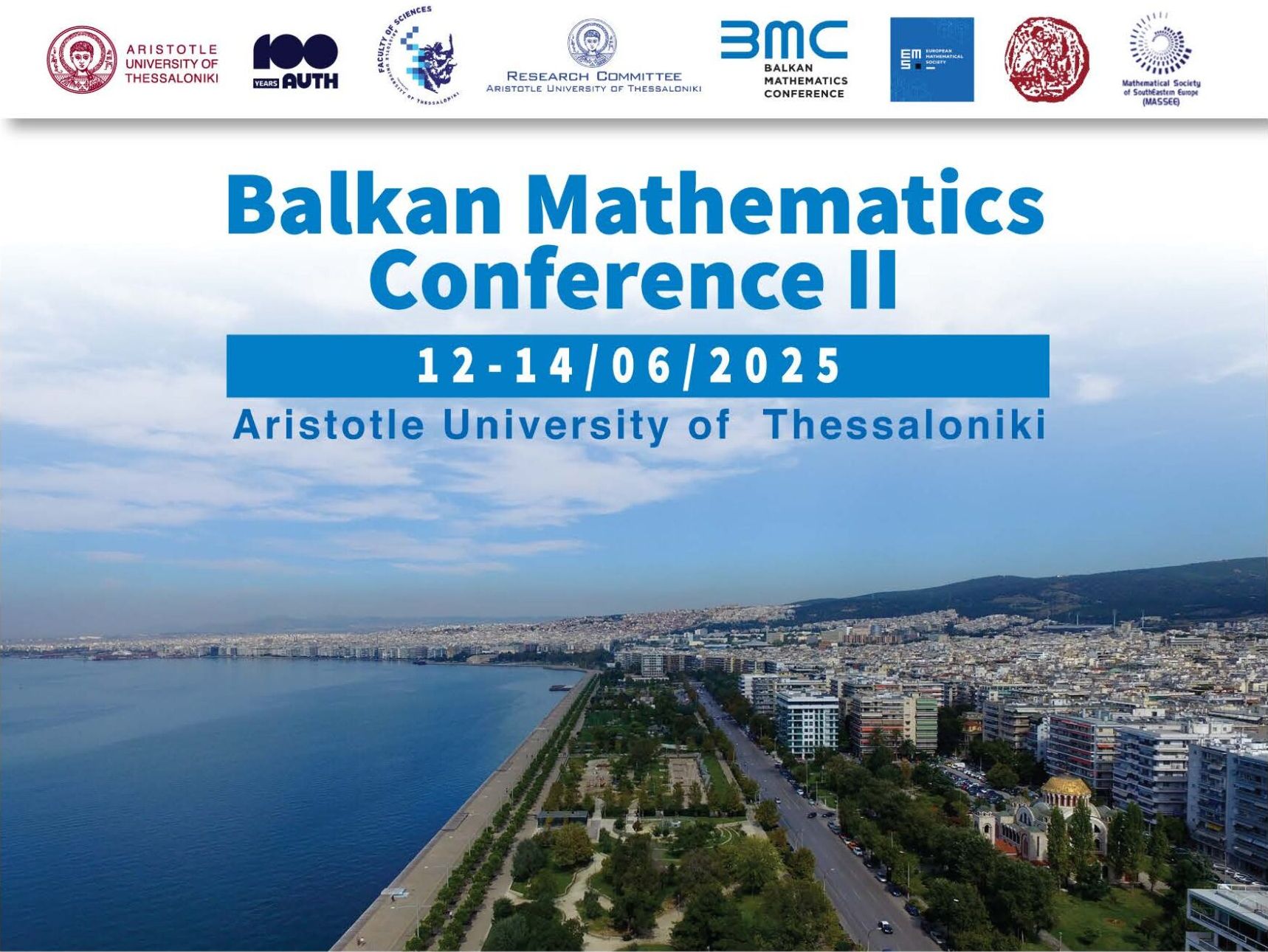
Poster for the Balkan Mathematics Conference II.
🅭🅯 CC BY 4.0This might be hard to imagine for mathematicians in the West, where there are lots of individual members, and where a good communication exists between institutes, universities, allowing to make known the possibilities offered by the EMS.
Our committee aims to balance this out. To help with the lack of information, I suggested the audience to look at the EMS homepage, with News (among others, information on coming conferences, fresh information), Magazine (free quarterly journal) and calls for grant applications. This is free for everybody, so people would not feel so isolated. With the internet these days, there are also lots of free sources, like Google, Google Scholar, arXiv, zbMATH Open, MathSciNet, etc.
How can our committee help you?
Twice a year we have a call for individual mathematicians to apply for travel grants to another place – perhaps with more resources – and for organizing a conference or workshop.
Let us look at these possibilities.
1. Travel grants
Offered to mathematicians in a less wealthy country without appropriate financial support.
Priorities include, without being restricted to these:
early-career researchers (max. ten years after PhD degree);
colleagues beyond retirement age who are still active.
These grants are for
presenting results at conferences;
attending courses;
research stays in foreign countries;
work with colleagues and access to libraries.
Criteria include:
scientific achievements and potential of the applicant;
scientific value of the goals of the applicant;
residence in a less wealthy country with fewer resources. I would underline this criterion; that has not been done well up to now in our committee. This will be addressed in greater detail later on.
How much support can you get?
Max. 500 Euros for destinations within Europe;
Max. 900 Euros for trips from Europe to destinations outside Europe.
Let me mention that the European Solidarity Committee does not support applications from outside Europe to Europe, but there is another committee, the Developing Countries Committee, to which one can apply for some financial help from a developing country to Europe. Another committee you can apply to is the Women in Mathematics Committee if you plan to attend a workshop or conference organized mainly for women.

Group photo at the Balkan Mathematics Conference II in Thessaloniki. (Courtesy of Andreas Koutsogiannis)
🅭🅯 CC BY 4.0What do you need to apply?
Scientific curriculum vitae with list of publications (date of the PhD degree). This is very important: we sometimes get too short or too long curriculum vitae; prepare it very well!
Description of the scientific content related to the proposed activity (abstract or project summary).
Proof of the acceptance by the partner institution.
2. Event funding grants
Offered for organizing scientific events of conferences.
Who is favored to get this support?
Qualified mathematicians from less wealthy countries without financial support.
The priorities include without being restricted to these:
Early career researchers (max. ten years after PhD degree);
colleagues beyond retirement age who are still active;
support events organized in less favored places in Europe. I would underline this priority. There are two possible ways: either you apply from a less favored country for a conference in a more favored country with some colleagues or apply for a conference in a less wealthy country. This makes it possible for people to participate in their home country without high travel costs.
Criteria:
include scientific value of the event;
its impact on the place where it is organized.
How much support can you get?
Max. 3000 Euros for each activity.
As an example, I would point out the recent conference in Istanbul “Model Theory Days,” May 17–20, 2025, supported by the European Solidarity Committee with 1500 Euros; although this is not a big amount, it did make possible to organize the conference. Let me also mention that if you already have some support from some source, it is easier to find other support, as for instance was done in Istanbul.
By the way, in Turkey, as Özlem Beyarslan, a committee member, mentioned, information on the European Solidarity Committee grants is distributed to all universities in the country, which is a great way to let mathematicians know about these possibilities.
Event-funding grant application:
scientific curriculum vitae of the organizers with a list of publications;
preliminary budget for the entire event, including expected other funding sources;
an explanation on how EMS funding will be used;
details about the main lines of the event;
preliminary list of speakers and participants.
Deadlines for both grants
There are two application rounds through each year.
First round: opens on October 7, deadline January 31. Decisions are made in March.
Second round: opens on February 1, deadline September 30. Decisions are made in November.
Warning: Keep track of the decision time, the workshop should not be planned before March and November of the year, respectively!
Application process
Register an account on Google Grants and log in.
Browse the list of open calls in the “Apply section” and select the item you wish to apply for.
Complete your application and submit it for review before the deadline.
You can revise your application online as many times as you want, until the deadline.
If you have questions, feel free to contact Markus Juvonen, juvonen@euromathsoc.org.
It is a technical procedure, you will be able to submit your application, do not be afraid!
Let me show some data from our last round on individual grants. We received 19 applications, and very few of them are from less wealthy countries. I believe that the reason is that the availability of these is not yet known in those countries.
| number | from | to |
| 2 | Germany | USA |
| 2 | United Kingdom | Canada |
| 1 | Finland | United Kingdom |
| 1 | France | Japan |
| 1 | Italy | Austria |
| 1 | Italy | Canada |
| 1 | Italy | Kazakhstan |
| 1 | Italy | Netherlands |
| 1 | Italy | Poland |
| 1 | Italy | Portugal |
| 1 | Italy | United Kingdom |
| 1 | Italy | USA |
| 1 | Portugal | USA |
| 1 | Romania | Belgium |
| 1 | Romania | France |
| 1 | Turkey | Greece |
| 1 | United Kingdom | France |
And here is the list of 26 applications for event grants:
| number | from | to |
| 7 | Italy | Italy |
| 3 | France | France |
| 3 | Portugal | Portugal |
| 2 | Netherlands | Netherlands |
| 2 | United Kingdom | United Kingdom |
| 1 | Germany | Denmark |
| 1 | Germany | Italy |
| 1 | Germany | Netherlands |
| 1 | Italy | France |
| 1 | Italy | Sweden |
| 1 | Netherlands | Germany |
| 1 | Poland | Turkey |
| 1 | Romania | Romania |
| 1 | United Kingdom | Germany |
Even worse! Where are the less favored countries? People should be aware that the level of these countries is very different from that in the more favored countries. But how can you pay for a scientific trip or organize a conference when you have difficulties paying your Society fee? That is the mission of the European Solidarity Committee, to help those mathematicians.
Talking to people at the conference, I met many mathematicians who – for some reason – left their home country and now live somewhere else. A beautiful mission for them would be to organize a conference in their home country, with colleagues still living and working there. This would fertilize the mathematical life in their home country. Come back and improve the level of mathematics research and teaching in your home country!
The individual grants are also very important for those countries. Apply for a travel grant, go to a country with better resources, work with colleagues there, use the libraries, and come back to raise the level of mathematics at home.
Unfortunately, we could not achieve these objectives yet, but we are working on it. As already mentioned above, the main problem must be that in those less favored countries people are not aware of these possibilities.
To highlight the importance of these events for less wealthy countries:
In most areas of mathematics there are not many people working on fashionable topics.
They might be particularly important for mathematicians who might be isolated in their field to be part of a larger community that will understand and appreciate their work.
In smaller countries, academic leaders may be unaware or not appreciate some areas of mathematics. It is natural.
For this reason, it is important that the European Solidarity Committee supports more areas of interest than is possible in any one country. There are other gifted mathematicians who are not in the mainstream, and might feel isolated in, say, a smaller place.
Anyone in any European country is eligible to apply, even if she/he is not a member of the EMS and/or of the local society.
Individuals can apply on their own, not necessarily through their home university or institute.
One of the virtues of these grants offered by the European Solidarity Committee is that they give recognition to people whose colleagues and/or local university are unaware of the value of their work. It helps everyone, not just the applicant. It helps the university, the institute, it helps everybody.
Talking to Karine Chemla, we agreed that the committee has to be more active in advertising these grants in less favored countries, and have a contact person – not necessarily the head of the local main Mathematical Institute – someone who is willing to distribute the information to all universities and also smaller institutes in their country (as Turkey started to do).
When I met people at the conference, I noticed that about half of the participants came not from the Balkans; yet from our conversations it turned out that their home country is indeed one of the Balkan countries. And they do care about their home country, that is why they came! So, you are most welcome to organize a workshop or conference with your colleagues in your home country and encourage people there to visit you or other places, to collaborate and make your home country scientifically stronger!
I wish all of you success in your mathematical career!
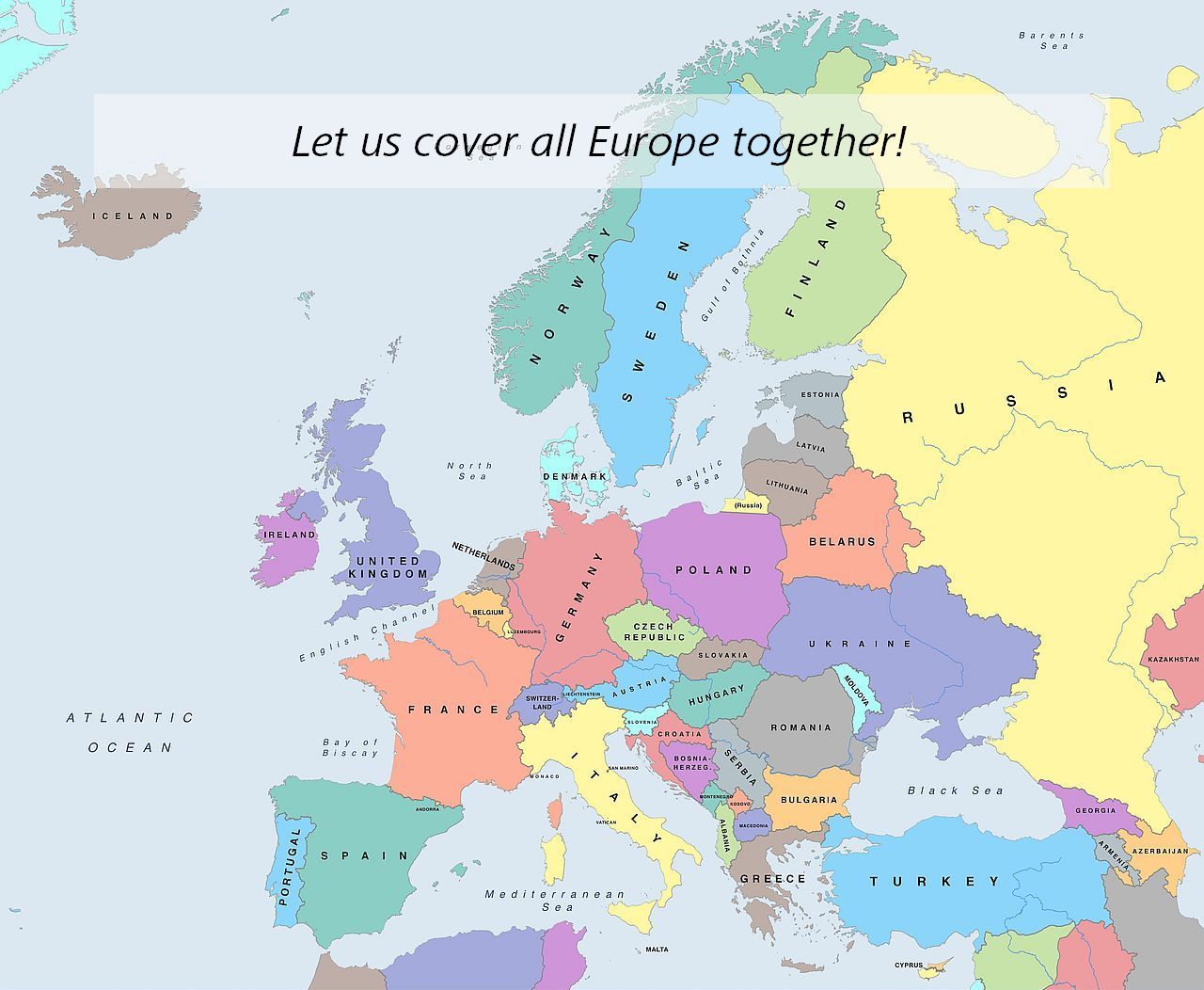
(Map courtesy of Mapswire.com)
🅭🅯 CC BY 4.0Cite this article
Alice Fialowski, On the European Solidarity Committee of the EMS. Eur. Math. Soc. Mag. 139 (2026), pp. 15–18
DOI 10.4171/MAG/302