
Peter David Lax passed away on May 16, 2025, having lived a long and riveting life. He was the last of the generation of great analysts who, in the mid-twentieth century, set the current directions in the field of partial differential equations.
Peter was born to a Jewish family in Budapest on May 1, 1926. His parents were established physicians, so he and his older brother John grew up in a comfortable, intellectual family environment. Peter demonstrated extraordinary mathematical ability from an early age.
The life of the family was turned upside down by the coming of World War II. Fortunately, the American consul in Budapest was a patient of Peter’s father and secured for them visas to the United States. Peter often recounted his memories as a fifteen-year old traveling in a sealed train from Budapest to Lisbon, through Germany, and boarding the last steamship to New York on October 5, 1941, just two days before the attack on Pearl Harbor.
Peter’s father set up a successful practice in New York City, with notable patients such as Béla Bartók, Alexander Korda and Greta Garbo. Eventually, the family settled in an apartment house on the Upper West Side which has become the residence of three Lax generations.
Peter’s reputation as a mathematical prodigy having preceded his arrival in the U.S., he was soon introduced to his famous compatriots John von Neumann and Gábor Szegő and also to Albert Einstein. On the recommendation of Szegő, who was actually a relative of Peter, he enrolled at the age of sixteen in the mathematics program of New York University, directed by Richard Courant.
Two years later, Peter’s studies were interrupted when he was drafted into the U.S. Army. Fortunately, he was assigned to the Manhattan Project and spent the bulk of his army service at Los Alamos, where he had the opportunity to become acquainted with prominent physicists and applied mathematicians—both senior, including Enrico Fermi, Edward Teller and Stanisław Ulam, and of his own generation, Richard Feynman, Richard Bellman and John G. Kemeny. Peter was particularly impressed by the intellectual power and scientific breadth of von Neumann, who thence became his hero.
At Los Alamos, Peter witnessed the effectiveness of applying mathematics to real-life problems and in particular the usefulness of scientific computation. These experiences are manifested in his future teaching and research. It thus appears that in addition to changing the course of his life, the Second World War also set the directions of his scientific work.
In 1946, Peter was discharged from the army and returned to NYU in order to complete his undergraduate work and to enroll in the graduate program. As a graduate student, he was fortunate to be exposed to the teaching of world-class experts in partial differential equations, including Courant, Kurt Friedrichs, and Fritz John, and also to be in the company of classmates like Joe Keller, Cathleen Morawetz, Harold Grad, Louis Nirenberg, and Martin Kruskal, who along with him would join the ranks of the next generation’s leading mathematicians. He completed his dissertation on hyperbolic equations, under the direction of Friedrichs, and was awarded the PhD in 1949.
Peter and several of his gifted classmates joined the faculty of NYU. The new appointees Lax, Nirenberg and Morawetz, together with Courant, Friedrichs and John of the older generation, rendered NYU the Mecca of partial differential equations in the U.S. throughout the mid-twentieth century.
As a researcher, Peter possessed a talent for early recognition of fertile open fields, along with the insight to discern internal, possibly simple, structures underlying complex mathematical phenomena. Illustrative examples of Peter’s contributions that look deceptively simple and yet played a central role in the development of the theory of linear partial differential equations and of numerical analysis in the 1950s are the Lax-Milgram lemma and the Lax equivalence theorem. Another demonstration of Peter’s insight is his work on integrable systems, in the late 1960s: A large family of partial differential equations had been derived over the years which possessed an infinite number of conserved integrals as well as soliton solutions with remarkable interaction properties. By introducing the celebrated Lax pairs, Peter solved the mystery by uncovering the abstract underlying structure shared by these diverse equations.
Another major contribution of Peter Lax, which opened a new chapter in the theory of partial differential equations, stemmed from his work on quasilinear hyperbolic systems in divergence form, which he dubbed hyperbolic conservation laws, a term that has now become standard. Numerous systems of this type, manifesting the conservation laws of classical physics, had been derived and studied over the years, beginning with the Euler equations that govern isentropic gas flow. In a seminal paper published in 1957, Peter distilled the diverse information that had been amassed over a period of two centuries and developed a systematic formalism for hyperbolic systems of conservation laws in a single spatial dimension which set the direction of research in the area up to the present time. Peter himself made further important contributions to that field by abstracting the notion of entropy and by building, in collaboration with Jim Glimm, a complete theory of BV solutions to pairs of conservation laws. He also contributed to the numerical analysis of hyperbolic conservation laws by developing, together with Burton Wendroff, the method associated with their names.
Of course, Peter Lax did important notable research in several other fields, for example in scattering theory, in collaboration with Ralph Phillips. However, his impact extends beyond his printed papers. Indeed, his views on applied mathematics circulated widely. He was an effective teacher and mentored a number of gifted students who then spread the word. He lectured extensively around the globe and participated in countless panels and governing boards.
Peter Lax also played a leading role in scientific administration, beginning with his service as Director of the Courant Institute over the period 1972 to 1980. He also served as Vice President and then President of the American Mathematical Society, as a member of the Board of Governors of the National Science Foundation, and on innumerable program evaluation committees.
Lax’s contributions were amply recognized by the international scientific community and he received a great number of honors, including major ones such as the Abel Prize, the Wolf Prize and the National Medal of Science. He was a member of the National Academy of Sciences, the Soviet Academy of Sciences, the French Academy of Sciences, the Hungarian Academy of Sciences and the Academia Sinica.
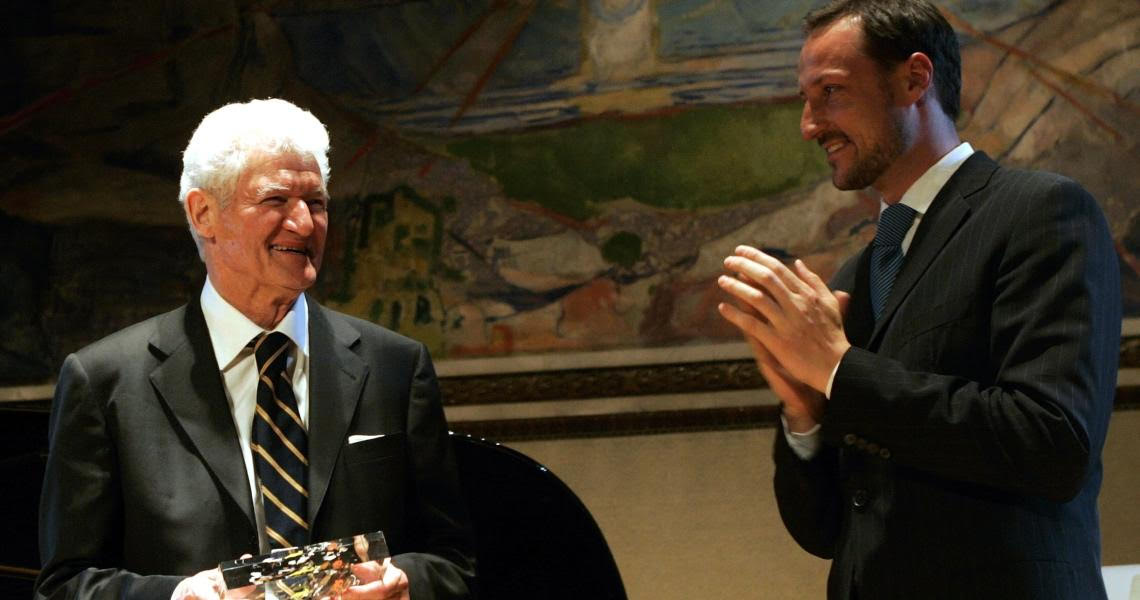
Peter Lax receiving the 2005 Abel Prize from His Royal Highness Crown Prince Haakon in the aula of the University of Oslo. (Photo: Scanpix, by courtesy of The Abel Prize)
©© Scanpix / The Abel Prize
The single word that would describe Peter’s personality is “charm,” which radiated to people of any age and gender. His charm was inseparable from his generosity, in scientific matters as well as in everyday life. He encouraged and nurtured his numerous students together with many other younger mathematicians. In fact, my first acquaintance with Peter and his work, back in 1969, set to a great extent the direction of my scientific work.
Peter was very cosmopolitan. He arrived in the U.S. young enough to become fully immersed in American culture and yet mature enough to have retained vestiges of the culture of his native Hungary, including slight traces of a Hungarian accent. His cosmopolitanism was further nurtured by his tenure at the Courant Institute, in the company of teachers, colleagues and students from all over the world. He was also a fabled storyteller about his encounters with notable people.
Peter was a keen follower of national and international politics. He was of liberal persuasion and abhorred totalitarian regimes, left and right. My impression is that he was a pragmatist rather than an ideologue. In fact, as I recall, he once told me that “moderation” was his favorite word in the lexicon.
In 1948 Peter married Anneli Cahn, a classmate in graduate school and later a colleague at the Courant Institute. They had two sons, Johnny and Jimmy. Unfortunately, Johnny died in 1982, in a tragic traffic accident, and this was a severe blow to his parents and I could see Peter’s emotional reaction whenever he visited Brown University, which was Johnny’s alma mater. Jimmy became a physician and stayed close to his parents. Anneli died of cancer in 1999 and in 2006 Peter married the violist Lori Berkowitz, who was the widow of the mathematician Jerry Berkowitz and the daughter of Courant; she also preceded him in death.
It is amusing to observe the quirks of famous scientists. Since the time he was young, Peter often dozed during lectures, and lecturers who were not aware that this was habitual felt disappointed and occasionally even insulted. At the conclusion of lectures, Peter made sure to ask relevant questions to the lecturer to demonstrate that he could follow even when he was asleep!
Peter’s life touched the lives of many people. Neither the man nor his work will be forgotten.
Cite this article
Constantine M. Dafermos, Obituary of Peter Lax. Eur. Math. Soc. Mag. 139 (2026), pp. 33–34
DOI 10.4171/MAG/301