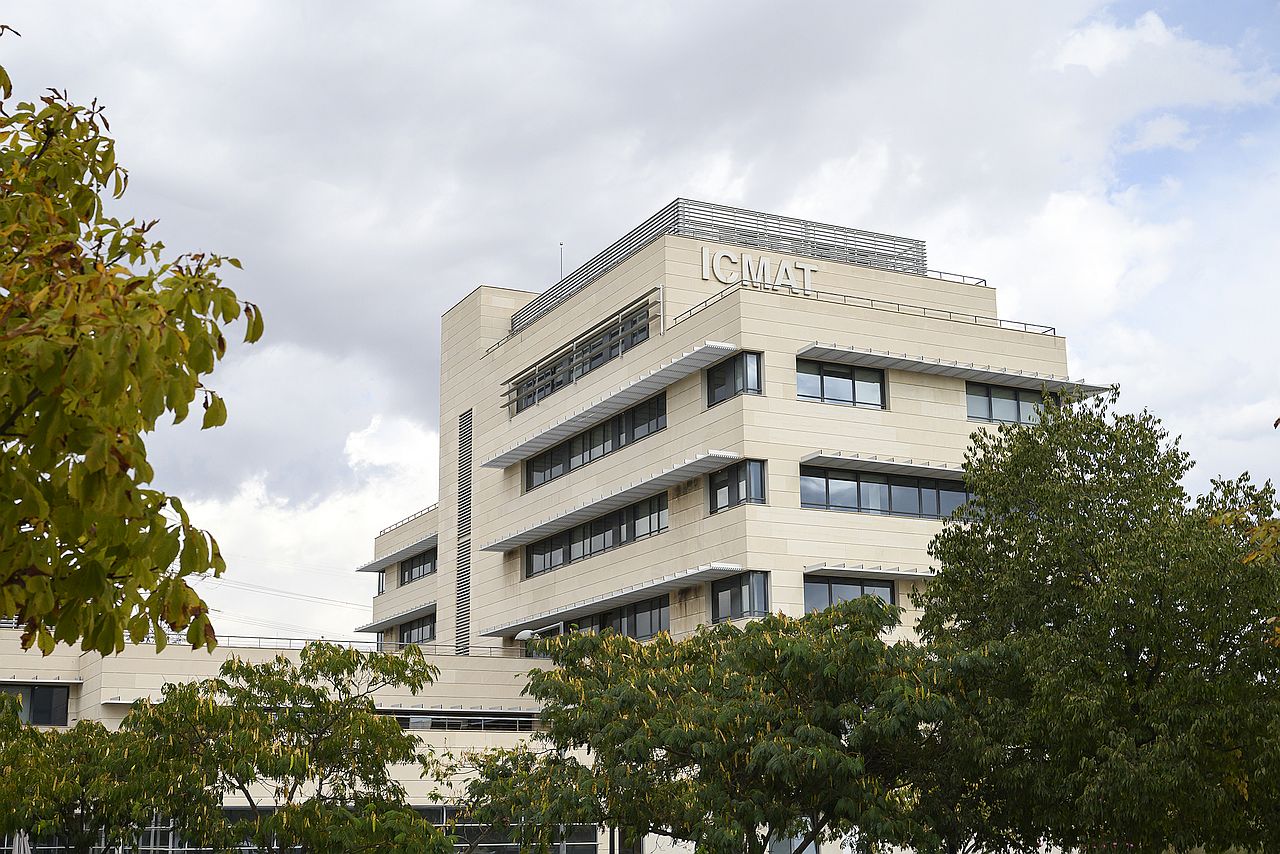
The Institute of Mathematical Sciences (ICMAT) in Madrid, Spain, celebrates this year its nineteenth anniversary, marking its consolidation as an internationally recognised research centre spanning all areas of mathematics. ICMAT is a joint initiative of the Spanish National Research Council (CSIC, the country’s largest public institution devoted to scientific and technical research, under the Ministry of Science, Innovation and Universities) and three leading public universities in Madrid with strong traditions in mathematics: the Universidad Autónoma de Madrid (UAM), the Universidad Complutense de Madrid (UCM), and the Universidad Carlos III de Madrid (UC3M).
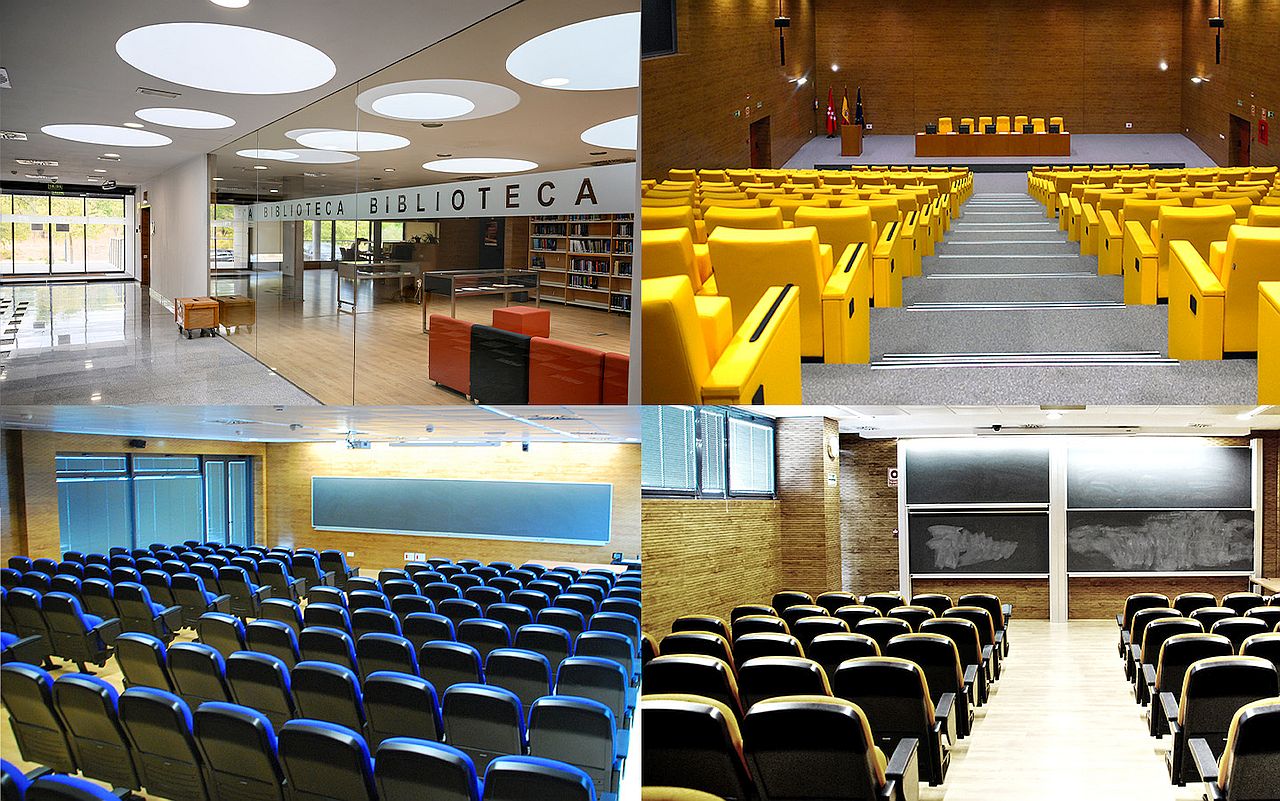
ICMAT was founded in 2007 and moved in 2010 to its current building, a modern facility offering excellent infrastructure for mathematical research. Despite its short history, the institute has established itself as a leading mathematics centre in Europe, both in terms of research excellence and scientific activity.
ICMAT’s international standing is reflected in several indicators. To date, its researchers have secured 12 European Research Council grants across the Starting, Consolidator and Advanced categories, amounting to about half of all ERC funding awarded in Spain within the Mathematics panel (PE1). These projects span areas such as singularity formation in the Euler and Navier–Stokes equations; geometry-driven phenomena in fluid mechanics, PDEs and spectral theory; harmonic analysis; partial differential equations and geometric measure theory; quasiconformal methods and their applications; and restriction phenomena for the Fourier transform with implications for Schrödinger and wave equations. In these and other fields, ICMAT researchers are recognised as international leaders.
In addition, the institute has strengthened its presence at the discipline’s leading forum, the International Congress of Mathematicians. At the upcoming 2026 ICM in Philadelphia (USA), two ICMAT researchers will be invited speakers: David Pérez García, for his work on the mathematical classification of quantum phases of matter, and Javier Parcet, for his advances on Connes’ rigidity conjecture in functional analysis and geometric group theory. This follows the invitation of Diego Córdoba as a speaker at the 2018 ICM in Rio de Janeiro.
ICMAT’s development has been supported to a significant extent by the Severo Ochoa and María de Maeztu Programme for centres and units of excellence, established in 2011 by the Spanish Ministry of Science, Innovation and Universities to identify and fund research structures of outstanding international impact. Each Severo Ochoa accreditation provides €4 million over a four-year period, together with approximately ten PhD fellowships. ICMAT has been part of the programme since its inception, receiving distinctions in 2011, 2016, 2019 and 2023, making it one of only five research centres in Spain, across all disciplines, to have obtained four such awards to date. This support has enabled the institute to implement its scientific strategy, firmly grounded in research excellence, high-impact scientific activity, the training of young researchers and a sustained commitment to strengthening the presence and value of mathematics within society.
Over 200 people committed to mathematical research
ICMAT’s evolution under the Severo Ochoa programme becomes evident when examining changes in personnel between 2010 (prior to the first award) and 2022. In 2010, the institute comprised 40 faculty members, 20 postdoctoral researchers, 29 graduate students and 5 management staff. By 2022, these numbers had risen to 65 faculty, 50 postdoctoral researchers, 45 graduate students and 11 management staff.
Permanent researchers are senior and highly influential scientists, many of whom have received prestigious distinctions. Notably, Diego Córdoba was awarded Spain’s National Research Prize in 2023 and Antonio Córdoba, former director of the centre, received the same prize in 2011. In addition, Alberto Enciso was honoured with the Princess of Girona Prize in 2014, and David Ríos Insua was awarded the AXA–ICMAT Chair in Risk Analysis. Several ICMAT researchers are also members of the Royal Spanish Academy of Sciences.
The vibrant international postdoctoral community at ICMAT, comprising around 60 researchers at any given time, plays a key role in the institute’s scientific dynamism. These early-career scientists are attracted through highly competitive calls and typically undertake two-year research stays, often supported by prestigious national and European fellowships. Their presence contributes to a constant renewal of research lines and fosters strong international collaborations. In parallel, ICMAT provides an outstanding training environment for young researchers: about 45 doctoral candidates are currently pursuing their PhD dissertations under the supervision of permanent staff, benefiting from close mentoring and an active programme of seminars, workshops and visiting scholars, while around ten master’s students each year are offered a structured introduction to research and receive close supervision for the development of their master’s theses.

Moreover, the institute further benefits from an excellent management team consisting of 11 people, working in areas such as IT services, project and grant management, outreach and communications, travel administration and the organisation of scientific events, providing essential support for the effective operation of the centre. This team has been created thanks to the Severo Ochoa programme, and its work is essential to the development and functioning of the institute’s scientific activity.
In line with its commitment to nurturing talent at all career stages, ICMAT has also developed several initiatives addressing equality and gender issues within the mathematical community, a field in which a significant gender gap persists worldwide. These sustained efforts were formally recognised with the CSIC Gender Equality Accreditation Distinction, awarded to the institute in 2021.
Research structure
ICMAT’s research activity is currently organised into three main scientific groups:
Group A: Algebra and Geometry. Focused on areas such as abstract algebra, algebraic geometry, differential geometry and topology, including fundamental questions in group theory, number theory, geometric mechanics and their applications in mathematical physics.
Group B: Mathematical Analysis and Differential Equations. Encompassing harmonic analysis, partial differential equations, geometric group theory and functional analysis, with research ranging from classical analytical problems to applications in mathematical physics.
Group C: Applied Mathematics. Working at the interface of mathematics with data science, machine learning, quantum information and mathematical modelling for scientific and technological applications.
Research conducted at ICMAT is regularly published in leading mathematics journals, including Annals of Mathematics, Acta Mathematica, Inventiones Mathematicae, the Journal of the American Mathematical Society, Duke Mathematical Journal and the Proceedings of the National Academy of Sciences, among others.
These achievements also translate into research projects funded through various competitive instruments, both national and international. Beyond the ERC grants, ICMAT participates in European Union schemes ranging from Marie Skłodowska-Curie Actions in Pillar I to projects within Pillar II, Global Challenges and European Industrial Competitiveness. In Spain, ICMAT researchers lead over 30 research projects annually, primarily funded by the Spanish State Research Agency (AEI), the main public funder of basic research in the country.
Intensive research activity
A significant proportion of ICMAT’s scientific activities is funded through the Severo Ochoa programme. A central component of this scientific programme is the Severo Ochoa Laboratories and Distinguished Visiting Professors Programme, designed to strengthen research groups led by internationally renowned external researchers.
The ICMAT–Severo Ochoa Laboratories create local research clusters led by one or two exceptionally strong mathematicians, selected through a competitive international process. Each laboratory receives funding for scientific activities, including the organisation of a thematic programme, as well as support for predoctoral and postdoctoral positions. They provide a natural framework for collaboration among research lines aligned with the interests of the laboratory director(s), enhance ICMAT’s international visibility and contribute significantly to the training of young researchers.
The fourth edition of the programme, launched in 2024, features eight laboratory directors: Martin Bridson, Ignacio Cirac, Charles Fefferman, Ngô B%̉
ao Châu, Nigel Hitchin, Gilles Pisier, Alan Reid and Mikael de la Salle. The current distinguished visiting professors are Bruno Anglès, Elena Celledoni, Monika Ludwig, Eugenia Malinnikova, Eero Saksman and Eva Miranda.
Since its creation in 2012, the programme has included prominent laboratory directors such as Ian Agol, Simon Donaldson, Viktor Ginzburg, Marius Junge and Stephen Wiggins, and Distinguished Visiting Professors including Kari Astala, Anthony Bloch, Filippo Bracci, Anthony Carbery, Juncheng Wei, Marius Junge and Rafael de la Llave.
Fostering mathematical vocations
As part of its scientific strategy, ICMAT maintains a strong commitment to training new generations of mathematicians. Beyond its participation in standard master’s and doctoral programmes, the institute develops its own initiatives aimed at fostering and identifying early mathematical talent.
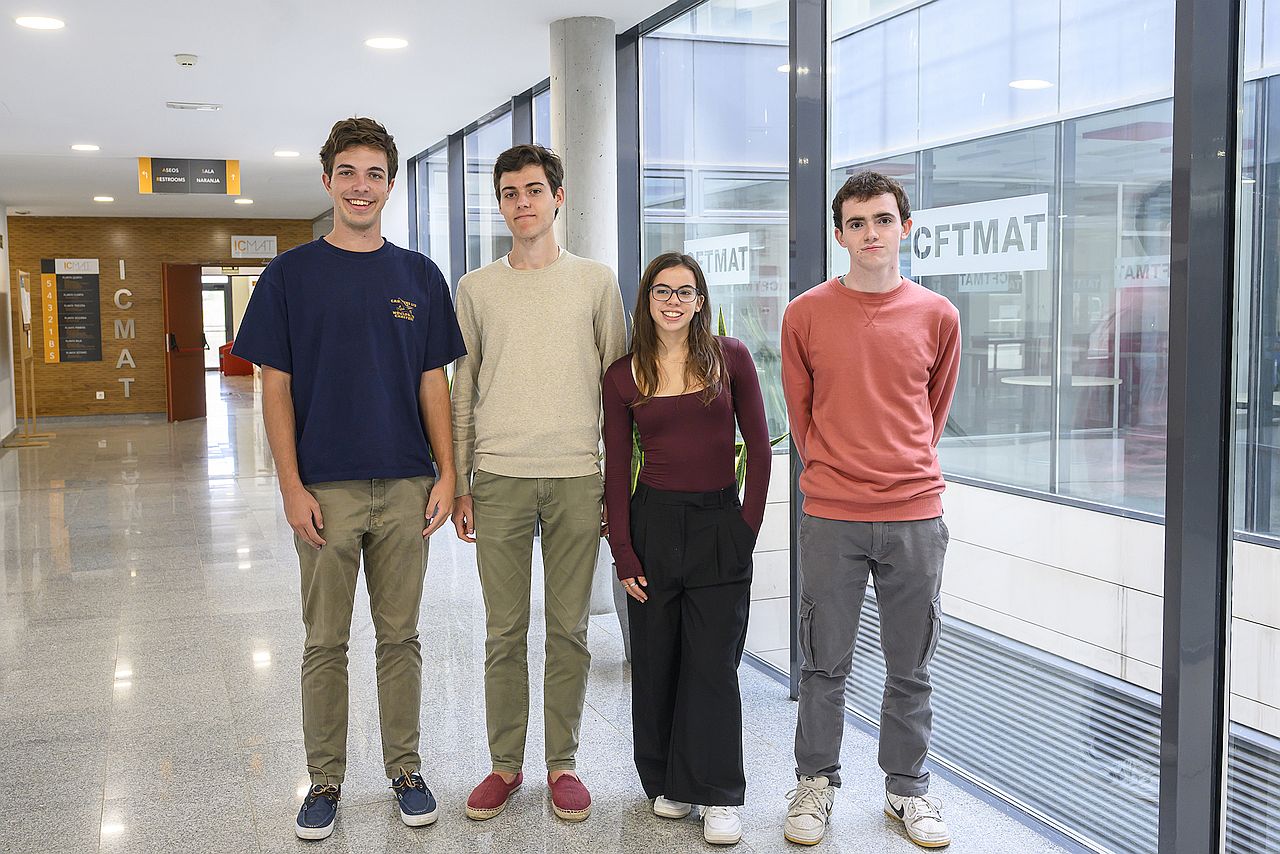
In 2025, ICMAT launched the Mathematics Intensive Programme (MIP), the first intensive training programme for undergraduate mathematics students in Spain. The aim of MIP is to offer a very small group of undergraduates with extraordinary mathematical talent a high-level complementary education in a stimulating environment. The programme fills an important gap in the Spanish system, which previously lacked a structured initiative to nurture the early development of highly capable university students, as found in other European countries.
Four students have taken part in this inaugural edition, selected from more than 70 applicants. Each has been assigned an ICMAT researcher as mentor for the duration of their degree. In addition to mentorship, MIP offers advanced minicourses and other activities, open upon registration to other undergraduates. At the end of each academic year, participants present a mathematical project before ICMAT researchers, and upon completing their undergraduate studies receive an official certificate from the Spanish Research Council (CSIC) accrediting their participation in the programme.
Through MIP, ICMAT expands its long-standing commitment to mathematical training, which already includes the Pequeño Instituto de Matemáticas (PIM). In this programme, every Friday during the school year, 150 students aged 12 to 18 gather at ICMAT to explore mathematics in an engaging, problem-solving environment that differs from standard classroom instruction. Launched in 2022–2023, PIM provides a setting for young people passionate about mathematics to develop their interest and curiosity.
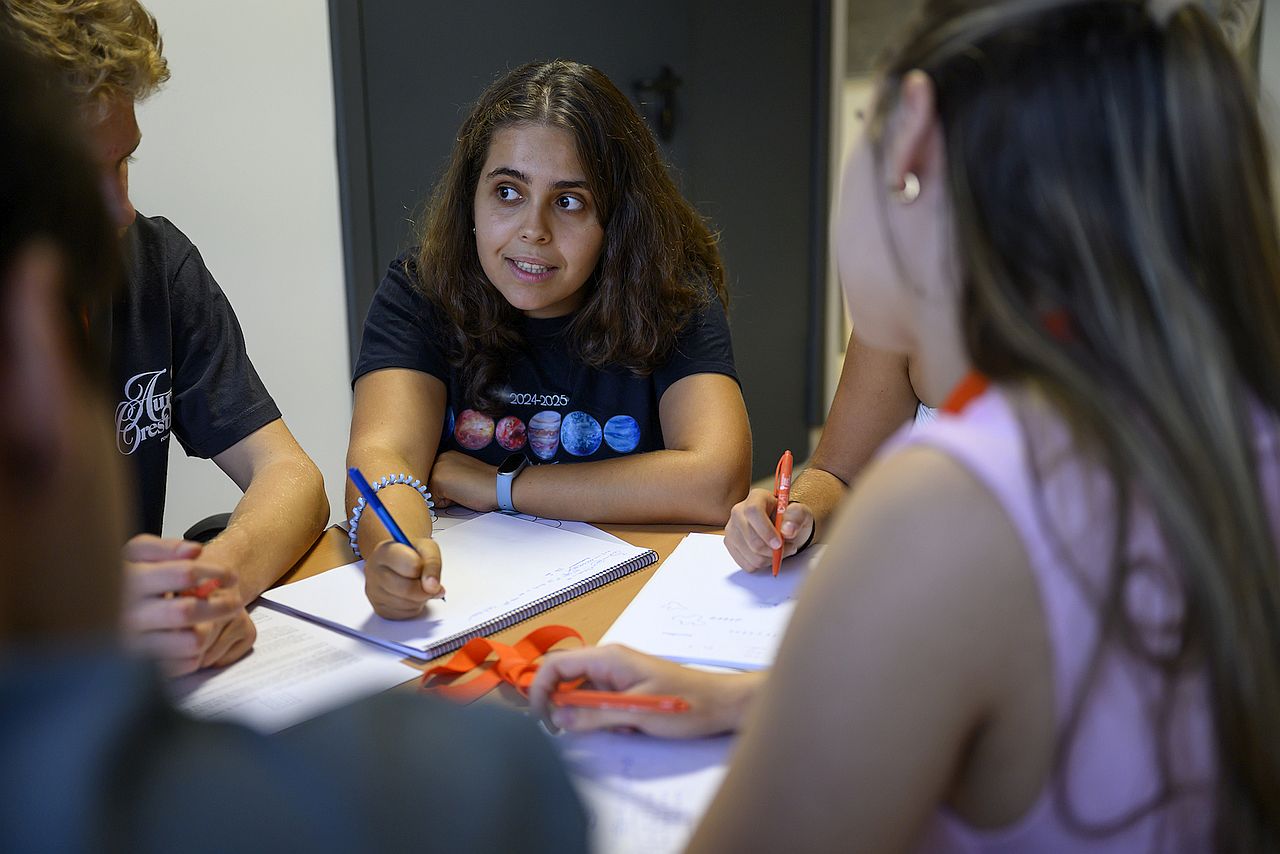
ICMAT also organises the JAE School of Mathematics, held annually for senior undergraduate and master’s students. Over two weeks, around 100 participants engage directly with cutting-edge research topics and interact with active researchers. In parallel, the Severo Ochoa Introductory Research Fellowships (INTRO-SO) offer 25 undergraduate students (and exceptionally, master’s students) a one-month training placement supervised by an ICMAT researcher, introducing them to the institute’s research lines and scientific activity.
Beyond the mathematical community
ICMAT is also a pioneering centre in the communication and dissemination of mathematics. In 2012, it created its Mathematical Culture Unit, staffed by professionals dedicated to outreach and public engagement who work closely with researchers and partner institutions to bring mathematics to diverse audiences. In 2014, the unit was recognised as a Scientific Culture Unit by the Spanish Foundation for Science and Technology, becoming the only specialised mathematics unit with this distinction. Its head, Ágata Timón, has been invited to participate in a round table on mathematics communication at ICM 2026 in Philadelphia (USA).
The unit produces original content on ICMAT’s scientific activities (newsletters, website news items and interviews, and audiovisual material for major social networks) and collaborates actively with mainstream media. For ten years, it coordinated the mathematics section Café y teoremas in El País, publishing around 400 articles by contributors from around the world and reaching more than one million readers annually. Two new sections succeed this initiative in 2025: Dimensión Fractal in elDiario.es and Entre teoremas in ABC.
In addition, the unit organises around thirty workshops, lectures and other activities each year for general and school audiences, presenting mathematical topics in an engaging and accessible manner.
ICMAT also plays an active role in the structuring of Spanish and European science. Nationally, its director, Javier Aramayona, serves as second vice-president of SOMMa, the alliance of Severo Ochoa centres and María de Maeztu units, of which ICMAT is a member. At the European level, he is vice-president of ERCOM, the committee of the European Mathematical Society that brings together Europe’s leading mathematics research centres. ICMAT has been a member of ERCOM since 2016.
Cite this article
Javier Aramayona, Ágata Timón García-Longoria, Nineteen years of ICMAT: strengthening excellence in mathematical research. Eur. Math. Soc. Mag. 139 (2026), pp. 37–40
DOI 10.4171/MAG/298