Since last July (2024), a new museum dedicated to mathematics and its key figures has opened in Beaumont-de-Lomagne,1At one-hour drive North-West from Toulouse (south of France). At 45 minutes from the international airport Toulouse-Blagnac, 35 minutes from Montauban, 25 minutes from Castelsarrasin. There is no railway station in Beaumont-de-Lomagne, but there are such stations in Montauban and Castelsarrasin. the birthplace of Pierre (de) Fermat. The Fermat Science Association, founded in the 1990s and responsible for the design of this museum, has extensive experience in promoting mathematics to the general public and schoolchildren. With the opening of this museum, the association is fulfilling its initial goals: promoting access to mathematical culture for all, popularizing mathematics, and energizing the birthplace of Pierre de Fermat.
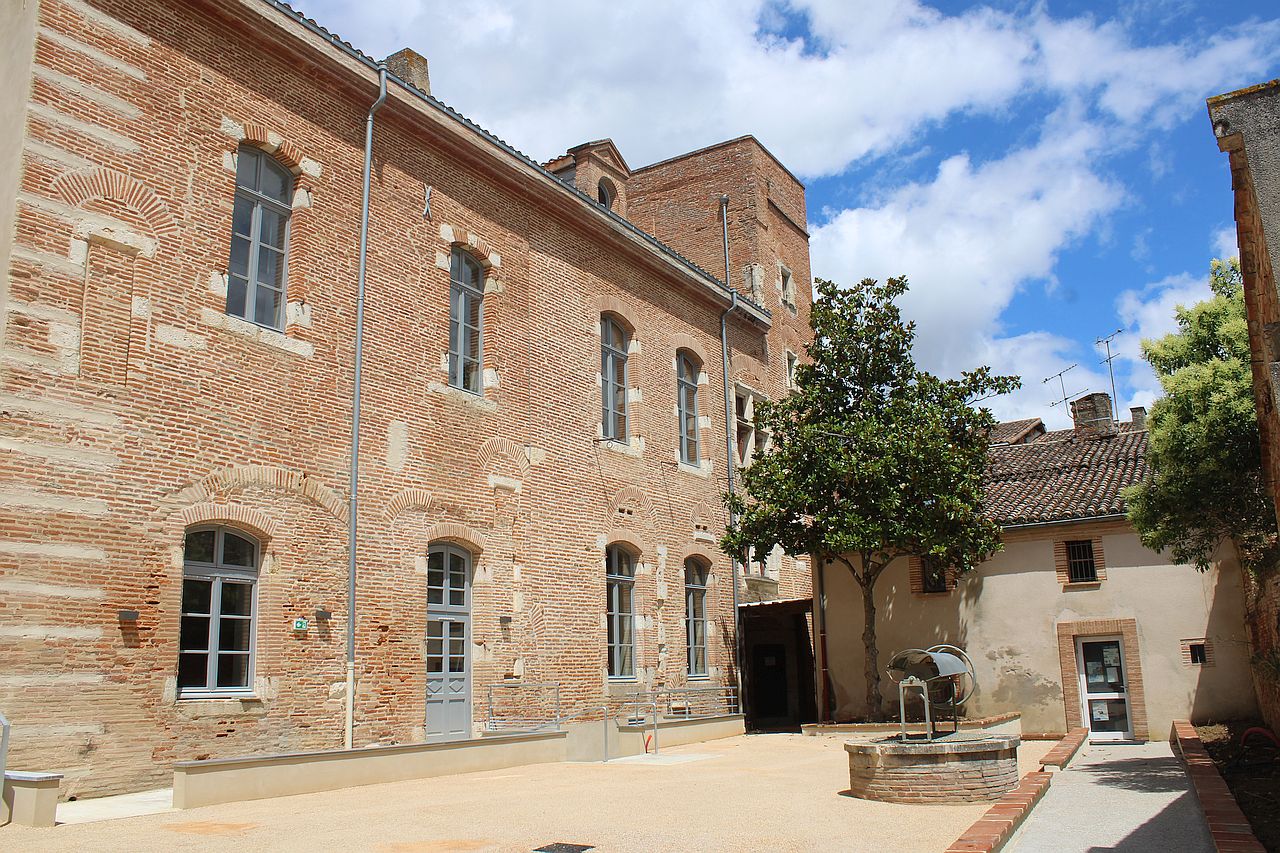
The Fermat family mansion. (Courtesy of Fermat Science Association)
🅭🅯 CC BY 4.0The museum is housed in the private mansion of the Fermat family. The building dates back to the 16th century, and in this historic location, architects have created an outstanding museum structure while preserving the most prestigious elements of the former residence. Beaumont-de-Lomagne is a town of about 4,000 inhabitants located in Tarn-et-Garonne, at about sixty kilometers from Toulouse. The challenges of establishing the museum in a rural area, far from cultural centers, as well as the expected audience, mainly families and school groups, led to the design of an original space divided into three sections: at the start of the visit, the focus is on the architectural heritage and 17th-century history; then the mathematics of the 17th century; and finally, contemporary mathematics.

Pierre de Fermat (engraving by François Poilly, ca. 1679).
🅭🅯 CC BY 4.0We first step into the intimate world of Pierre de Fermat. A hologram recreates the mansion as it appeared in the time when the mathematician lived there. A family tree represents the three families from which Pierre de Fermat and his wife Claire Delong came. It also shows the interactions between the two religious groups, Catholic and Protestant, as well as the evolution of society towards an increasing importance of the merchant bourgeoisie and its rise to the nobility through the judiciary. Fermat was appointed magistrate to the Toulouse Parliament in 1631. He lived between his hometown, Toulouse, and Castres (at one-hour drive from Toulouse), where he was repeatedly appointed to sit in the Chambre de l’Édit, a chamber composed equally of Catholic and Protestant magistrates.
The major events of the 17th century, whether political, religious, or scientific, are recounted through a so-called “game of goose,” created for this purpose.
In the next section, we imagine Fermat’s library. We know his main readings from his correspondence. Among the key documents in this library are Apollonius of Perge’s Conics and Diophantus’ Arithmetica in a Greek-Latin version. Fermat owned a copy of the latter (now lost), in which he wrote in the margin the well-known conjecture that was made famous after its proof by Andrew Wiles in 1994. Also highlighted are Viète’s Ars Analytica, Fermat’s favorite book from which he gained his algebraic knowledge, and Bachet de Méziriac’s Problèmes plaisants et délectables. Several public activities, such as magic squares, are based on this book of “mathematical recreations.”
On the mathematical side, a room is dedicated to the scientific fervor of the early 17th century, to the République des Lettres originally fostered by Father Mersenne, who created a European communication network for scholars. A focus on the cycloid, the “queen of curves,” which fascinated many of Fermat’s contemporaries, illustrates this idea.

The 17th-century corridor. (Courtesy of Fermat Science Association)
🅭🅯 CC BY 4.0The final section of the permanent exhibition is dedicated to contemporary mathematics. Interactive devices explore some areas of modern mathematics linked to Fermat’s work (probability, optimization, number theory).
The contribution on probabilities is discussed through the Problème des partis, which was the main subject of the correspondence between Fermat and Pascal in 1654. A game of chance between two players (with initial stakes) is interrupted before one of them wins. The question is how to fairly divide the stakes based on the number of rounds each player has accumulated (“sharing of stakes”), implying that, if the game were to resume, each player should bet the amount they received. A video game has been created to help understand this problem.
Fermat was one of the pioneers of future infinitesimal calculus with his Method for finding maximaand minima (heavily contested by Descartes). This area of mathematics is represented in the museum by a narrated video about optimal control, regarding the calculation of satellite trajectories (orbital transfers).
Finally, the story of Fermat’s Last Theorem, which captivated the most eminent mathematicians for several centuries before making headlines worldwide in the 1990s, is presented through a comic book and an exclusive interview with the main author of the proof, Andrew Wiles.
A room is also dedicated to temporary exhibitions. The first of these is titled Enter the World of AI. It was created by Fermat Science in partnership with the House of Mathematics and Computer Science in Lyons and the Poincaré House in Paris (two museums on mathematics which the EMS Magazine has covered in recent issues). The next exhibition will start in January 2026, on mathematics and cooking (Dans ma cuisine).
Children aged 3–8 are also given significant consideration. A space is dedicated to them, currently organized around geometric shapes through construction games. This area is set to evolve to feature “Emmy the Fox,” an activity created within the framework of the Fermat Science Association’s relations with its European partners, which will invite younger audiences to appreciate mathematics as soon as January 2026.
In this unique place, aimed at family, tourists, and school audiences, we sought to involve visitors as much as possible throughout the journey, which is made possible by the technological tools available today. Manipulations, puzzles, and challenges are part of the experience.
Our goal is to immerse the visitor in the life of a 17th-century family, honor the memory of Pierre de Fermat, and transmit his passion for mathematics to the public, offering “another perspective on mathematics” (“une autre idée des mathématiques”) by providing an innovative space around scientific and mathematical culture. These are the ambitions that guided the creation of this space.
More information and details on the website museefermat.com; contact at contact@museefermat.com.
- 1
At one-hour drive North-West from Toulouse (south of France). At 45 minutes from the international airport Toulouse-Blagnac, 35 minutes from Montauban, 25 minutes from Castelsarrasin. There is no railway station in Beaumont-de-Lomagne, but there are such stations in Montauban and Castelsarrasin.
Cite this article
Maryvonne Spiesser, The Fermat Museum in Beaumont-de-Lomagne (France), a new place to love mathematics. Eur. Math. Soc. Mag. 139 (2026), pp. 35–36
DOI 10.4171/MAG/283