
All rights reserved.
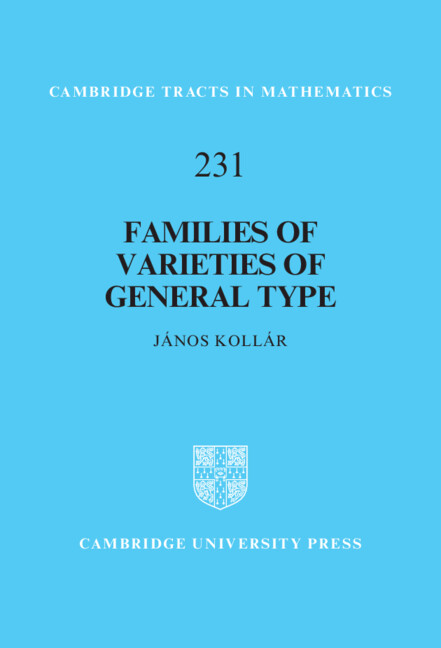
János Kollár’s Families of Varieties of General Type, written with the collaboration of Klaus Altmann and Sándor J. Kovács, is a monumental contribution to modern algebraic geometry. It completes a decades-long endeavor to generalize the moduli theory of algebraic curves to higher-dimensional varieties. The book concludes and brings to fruition a complete moduli theory for varieties of general type, a 30-year work by many mathematicians, where Kollár’s vision and contribution stand out. The importance of this monograph has been recognized by the János Bolyai International Mathematics Award, a prestigious prize given every five years by the Hungarian Academy of Sciences.
The work takes the moduli theory of hyperbolic (marked) curves as a starting point and guides the reader through the theory needed to generalize it to their higher-dimensional counterparts, namely, stable varieties and stable pairs. Throughout the text, the main focus is the notion of a family of varieties or pairs, consistently with the modern emphasis on functorial and stack-theoretic approaches to moduli. There are many subtleties in generalizing this notion from curves to higher-dimensional varieties. Step by step, the author addresses the natural difficulties that arise in the process and thus motivates the many new notions and constructions needed to develop the moduli theory for higher-dimensional varieties.
In the case of smooth and projective algebraic curves of genus , Deligne and Mumford developed a complete and satisfactory moduli theory: To construct a compact moduli space for curves of a fixed genus , it suffices to consider families of nodal curves of (arithmetic) genus . Furthermore, families of nodal curves over a base scheme are simple to describe: They are flat morphisms such that every geometric fiber is a nodal curve. Then, this description can be readily extended to curves of genus with marked points.
Already in dimension 2, if we consider smooth projective surfaces with ample canonical line bundle, it is not immediately clear what singular spaces should be allowed to compactify this moduli problem, nor what notion of family shall be used. The first question has been settled for some time and leads to the theory of stable varieties and stable pairs, which is thoroughly discussed in an earlier book by Kollár, Singularities of the Minimal Model Program. Yet, an answer to the first question only clarifies what geometric objects shall be parametrized, but not how. This book provides the answer to this latter question, thus completing the quest for a moduli theory generalizing the one of curves to higher dimensions.
In 1988, Kollár and Shepherd-Barron observed that the notion of family utilized for curves is not well-behaved already in the case of surfaces: relevant discrete invariants are indeed allowed to jump in a flat family. The core of the book (Chapters 2–7) discusses how the notion of flatness should be refined to obtain a well-behaved theory of families of stable varieties or pairs.
The first step is to understand what a family of stable varieties (or pairs) over a smooth curve is. In this case, since the base variety is smooth and 1-dimensional, the correct notion can be fully characterized with the language of pairs. Then, as we generalize this notion to arbitrary bases, more subtleties arise. To define a family of stable varieties over a reduced scheme , it suffices to ask that is flat and the relative canonical divisor is -Cartier. Then, if is not reduced, it is necessary to analyze all the sheaves and ask that they are flat and with fibers for every . This suffices to define the notion of family of stable varieties; for the case of pairs, the situation is even more intricate. Indeed, if we consider a candidate family of pairs , explicit examples show that we cannot expect the support of to be flat over . Therefore, a refined understanding of the possible alternatives to flatness is needed; this quest then leads Kollár to introduce the notions of C-flatness (inspired by Cayley hypersurfaces), well suited for families over reduced bases, and K-flatness, which generalizes the notion of C-flatness and provides the final notion needed to complete the theory.
Once the notion of family of stable varieties and pairs is fully understood, we are ready to harvest the desired results: The book culminates with the proof that the Kollár–Shepherd-Barron–Alexeev (KSBA) stability condition for pairs leads to a well-behaved moduli theory in characteristic 0, inclusive of a projective coarse moduli space.
The book is structured into eleven chapters, each progressively building toward the main results. A summary of the key sections includes:
Chapter 1: Provides historical background on moduli theory, tracing developments from Riemann and Cayley to Deligne and Mumford. It outlines the transition from curves to higher-dimensional varieties and highlights the main challenges therein.
Chapter 2: Develops the theory of 1-parameter families of (locally) stable varieties and pairs, including detailed definitions of local stability and the introduction of slc singularities.
Chapter 3: Treats the notion of a family of (locally) stable varieties over an arbitrary base. Approaches with the theory of Chow varieties (Cayley–Chow families) and Hilbert schemes (Hilbert–Grothendieck families) are compared.
Chapter 4: Establishes the core theory of stable pairs over reduced base schemes. The notions of Mumford divisor and C-flatness are introduced here as a crucial geometric condition for managing families of divisors.
Chapter 5: Provides numerical criteria for flatness and stability, most notably Theorem 5.1, which relates the constancy of the volume of the canonical divisor to the stability of families.
Chapter 6: Explores moduli problems where the divisorial part is flat and compares several notions of stability, including those due to Viehweg and Alexeev.
Chapter 7: Introduces K-flatness and its formal properties, which strengthen the framework for working with families of divisors independently of projective embeddings. This chapter provides the final notion of family of (locally) stable pairs over an arbitrary base.
Chapter 8: Synthesizes previous developments and the work of Chapters 2–7 into a general moduli theory for stable pairs, culminating in Theorem 8.1—the main result establishing that Kollár–Shepherd-Barron–Alexeev stability yields a good moduli theory with coarse projective moduli spaces.
Chapters 9–11: Contain auxiliary material such as hulls and husks, miscellaneous ancillary results, and a handbook about the Minimal Model Program.
To sum up, Families of Varieties of General Type is a landmark work that settles a central question in algebraic geometry. The clear and precise style will certainly make this book the main reference on moduli of algebraic varieties, both for learners and experienced researchers.
The exposition follows Kollár’s characteristic and enjoyable writing style: Abstract constructions or definitions go hand in hand with explicit and concrete examples that provide motivation and support for the reader. Another strength of the book is its historical account of moduli theory in algebraic geometry, which allows the reader to appreciate how the theory grew over the past two centuries and provides the more curious with many references to previous works.
This book’s contribution to algebraic geometry is both foundational and forward-looking. This is reflected by the multiple uses and audiences the book is suited for. On the one hand, its exhaustive content will make it an indispensable resource for researchers in moduli theory and birational geometry. On the other hand, graduate students and researchers interested in learning more about this field will find a reference rich in examples and motivations that will invite the reader to dive into moduli theory.
János Kollár, Families of Varieties of General Type. Cambridge Tracts in Mathematics 231, Cambridge University Press, 2023, xviii+472 pages, Hardback ISBN 978-1-009-34610-8, eBook ISBN 978-1-009-34611-5.
Cite this article
Stefano Filipazzi, Book review: “Families of Varieties of General Type” by János Kollár. Eur. Math. Soc. Mag. 139 (2026), pp. 51–52
DOI 10.4171/MAG/279