
All rights reserved.
This is a nice and well-written textbook on fractal geometry at the advanced undergraduate level. In order to study fractal geometry, some knowledge of measure theory is inevitably needed, and every author of a textbook on fractal geometry at the undergraduate level must decide how many technical details in measure theory he/she believes are needed and should be included. To answer this question, one is reminded of Tolstoy’s short story “How much land does a man need?” in which the protagonist, in the final paragraph, learns that the answer to the eponymous question is: “Enough to get buried in.” Similarly, many students have the impression that the answer to the question “How much measure theory do you need to study fractal geometry?” is also: “Enough to get buried in.” It is the duty of any author of a textbook on fractal geometry aimed at undergraduate students to carefully make sure that the students are not buried in measure theoretical details before starting the study of fractal geometry. Some authors achieve this by avoiding a technical discussion of measure theory, see, for example [2 G. A. Edgar, Measure, topology, and fractal geometry. Undergrad. Texts Math., Springer, New York (1990) , 5 K. Falconer, Fractal geometry: Mathematical foundations and applications. John Wiley & Sons, Chichester (1990) , 6 K. Falconer, Techniques in fractal geometry. John Wiley & Sons, Chichester (1997) , 11 Y. Pesin and V. Climenhaga, Lectures on fractal geometry and dynamical systems. Stud. Math. Libr. 52, American Mathematical Society, Providence, RI (2009) ], whereas others include carefully and appropriately designed chapters discussing the technical foundations of measure theory, see, for example, [1 M. Barnsley, Fractals everywhere. Academic Press, Boston, MA (1988) , 3 G. A. Edgar, Integral, probability, and fractal measures. Springer, New York (1998) , 10 P. Mattila, Geometry of sets and measures in Euclidean spaces: Fractals and rectifiability. Cambridge Stud. Adv. Math. 44, Cambridge University Press, Cambridge (1995) , 12 M. Zähle, Lectures on Fractal Geometry. Fractals Dyn. Math. Sci. Arts Theory Appl. 8, World Scientific, Singapore (2024) ]. The present book belongs to the latter category and includes a thorough discussion of measure theory.
The book consists of four parts.
Part 1 (“Preliminary Material”) consists of Chapters 1–3.Chapter 1 contains an interesting introduction to fractal geometry with many examples illustrating a wide variety of fractals. Chapter 2 and Chapter 3 contain technical material covering basic theory of metric space (20 pages) and measure theory including construction of measures using Carathéodory’s approach (40 pages), respectively.
Part 2 (“Dimension Theory”) is the core and central part of the book and consists of Chapters 4–8. Chapter 4 provides a thorough introduction to Iterated Function Systems, including symbolic dynamics. Chapters 5–7 provide an introduction to Hausdorff measures with respect to arbitrary gauge functions, including a detailed discussion of the -approximative Hausdorff measures with respect to different covering systems. Chapter 8 gives a thorough discussion of the Minkowski dimension and the box dimensions in addition to a detailed discussion of the Hausdorff dimension, the packing dimension and the box dimensions of self-similar sets satisfying the open set condition.
Part 3 (“Fractal Curves and Their Complex Dimensions”) consists of one long chapter (120 pages), namely, Chapter 9. This chapter provides an introduction to the theory of zeta functions and complex dimensions. While the material covered in Part 2 is standard and can be found in almost all undergraduate textbooks on fractal geometry, the material in Part 3 is less standard and was developed by Lapidus and various collaborators during the past 30 years, cf. [8 M. L. Lapidus, G. Radunović and D. Žubrinić, Fractal zeta functions and fractal drums: Higher-dimensional theory of complex dimensions. Springer Monogr. Math., Springer, Cham (2017) , 9 M. L. Lapidus and M. van Frankenhuijsen, Fractal geometry, complex dimensions and zeta functions: Geometry and spectra of fractal strings. Springer Monogr. Math., Springer, New York (2006) ] and the references therein. This is the first time this material is presented in a textbook for undergraduate students and this makes the present textbook unique amongst other undergraduate textbooks on fractal geometry. Because of this, it seems appropriate to explain the material in Part 3 in slightly more detail. Loosely speaking, the work presented in Part 3 says that the Minkowski dimension of a fractal string can be written as a series involving the poles of the zeta function of the fractal string. More precisely, for a bounded Borel set subset of , the distance zeta function of is defined by
for the complex variable , where and is the -neighbourhood of (the choice of is, in a precise technical sense explained in the book, unimportant), and the complex dimensions of are by definition the poles of the meromorphic extension of . The authors are particularly interested in the following special case. Namely, fix an open bounded subset of the real line and let be the boundary of ; the set is called a fractal string. A fractal string is typically a fractal set and fractal geometers are interested in studying the Minkowski dimension and the Minkowski content of . Lapidus’ key thesis is that the complex dimensions of provides an “explicit” formula for those quantities. More precisely, for , let denote the (-dimensional) volume of the -neighbourhood of . The Minkowski dimension, , of is defined by , and the lower and upper Minkowski contents of are defined by
One of the key results in Part 3 says that (under suitable conditions on the string ) we have the following explicit formula for :
where the sum is over all the complex dimensions of , the number is essentially the residue of at the pole , and is an error term of lower order. It follows from (1) that , where is a function defined explicitly in terms of the complex dimensions and whose oscillatory behaviour determines the values of the Minkowski contents and of .
Part 4 (“Appendices”) consists of two short appendices, A and B. Appendix A explain lower and upper limits, and Appendix Bprovides a more detailed and technical discussion of Carathéodory’s extension theorems.
The presentation is clear. Useful motivations and examples are presented before important definitions and details of all proofs are given. A very large number of further interesting historical notes and references are spread out through the text. Each section ends with a fairly large collection of useful exercises. Most of the exercises are not of a computational nature, but require that the reader provides proofs of various mathematical statements. Finally, the book contains a very long (633 entries) and useful list of references including many recent entries (i.e., after 2000).
There are numerous other textbooks in fractal geometry at the undergraduate level, including, [1 M. Barnsley, Fractals everywhere. Academic Press, Boston, MA (1988) , 2 G. A. Edgar, Measure, topology, and fractal geometry. Undergrad. Texts Math., Springer, New York (1990) , 3 G. A. Edgar, Integral, probability, and fractal measures. Springer, New York (1998) , 4 K. J. Falconer, The geometry of fractal sets. Cambridge Tracts in Math. 85, Cambridge University Press, Cambridge (1986) , 5 K. Falconer, Fractal geometry: Mathematical foundations and applications. John Wiley & Sons, Chichester (1990) , 6 K. Falconer, Techniques in fractal geometry. John Wiley & Sons, Chichester (1997) , 7 J. M. Fraser, Assouad dimension and fractal geometry. Cambridge Tracts in Math. 222, Cambridge University Press, Cambridge (2020) , 10 P. Mattila, Geometry of sets and measures in Euclidean spaces: Fractals and rectifiability. Cambridge Stud. Adv. Math. 44, Cambridge University Press, Cambridge (1995) , 11 Y. Pesin and V. Climenhaga, Lectures on fractal geometry and dynamical systems. Stud. Math. Libr. 52, American Mathematical Society, Providence, RI (2009) , 12 M. Zähle, Lectures on Fractal Geometry. Fractals Dyn. Math. Sci. Arts Theory Appl. 8, World Scientific, Singapore (2024) ]. The book under review is more advanced than Falconer’s 1990 texts [5 K. Falconer, Fractal geometry: Mathematical foundations and applications. John Wiley & Sons, Chichester (1990) , 6 K. Falconer, Techniques in fractal geometry. John Wiley & Sons, Chichester (1997) ] and the texts by Y. Pesin & V. Climenhaga [11 Y. Pesin and V. Climenhaga, Lectures on fractal geometry and dynamical systems. Stud. Math. Libr. 52, American Mathematical Society, Providence, RI (2009) ] and Zähle [12 M. Zähle, Lectures on Fractal Geometry. Fractals Dyn. Math. Sci. Arts Theory Appl. 8, World Scientific, Singapore (2024) ] but less ambitious than Mattila’s graduate textbook [10 P. Mattila, Geometry of sets and measures in Euclidean spaces: Fractals and rectifiability. Cambridge Stud. Adv. Math. 44, Cambridge University Press, Cambridge (1995) ]. Whereas Falconer’s popular textbooks [5 K. Falconer, Fractal geometry: Mathematical foundations and applications. John Wiley & Sons, Chichester (1990) , 6 K. Falconer, Techniques in fractal geometry. John Wiley & Sons, Chichester (1997) ] avoids technical measure theoretical details and presents a large number of examples of fractal sets taken from many parts of mathematics, the book under review provides the reader with the proper measure theoretical foundations for the subject (but at a level that is more accessible to the beginning graduate student than the treatment found in Mattila’s text [10 P. Mattila, Geometry of sets and measures in Euclidean spaces: Fractals and rectifiability. Cambridge Stud. Adv. Math. 44, Cambridge University Press, Cambridge (1995) ]) and concentrates on a more limited number of topics. The book is suited for an advanced undergraduate course in fractal geometry stressing the measure theoretical foundations of the subject. If supplemented with [5 K. Falconer, Fractal geometry: Mathematical foundations and applications. John Wiley & Sons, Chichester (1990) ], the students will learn the rigorous measure theoretical foundations for the subject and also encounter numerous interesting examples.
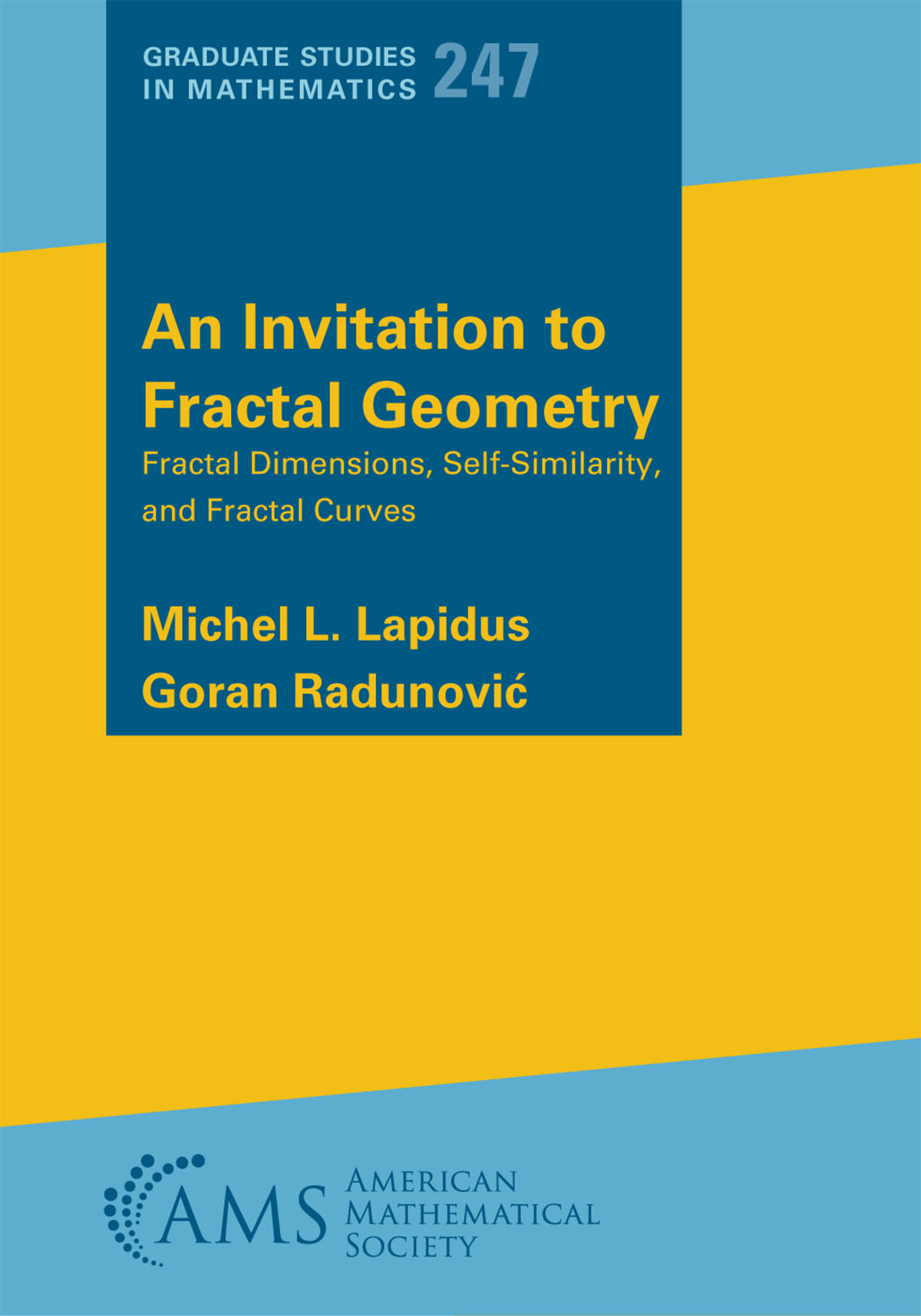
Michel L. Lapidus and Goran Radunović, An Invitation to Fractal Geometry: Fractal Dimensions, Self-Similarity, and Fractal Curves. Graduate Studies in Mathematics 247, American Mathematical Society, 2024, xxvii+600 pages, Hardcover ISBN 978-1-4704-7623-6, Softcover ISBN 978-1-4704-7895-7, eBook ISBN 978-1-4704-7896-4.
References
- M. Barnsley, Fractals everywhere. Academic Press, Boston, MA (1988)
- G. A. Edgar, Measure, topology, and fractal geometry. Undergrad. Texts Math., Springer, New York (1990)
- G. A. Edgar, Integral, probability, and fractal measures. Springer, New York (1998)
- K. J. Falconer, The geometry of fractal sets. Cambridge Tracts in Math. 85, Cambridge University Press, Cambridge (1986)
- K. Falconer, Fractal geometry: Mathematical foundations and applications. John Wiley & Sons, Chichester (1990)
- K. Falconer, Techniques in fractal geometry. John Wiley & Sons, Chichester (1997)
- J. M. Fraser, Assouad dimension and fractal geometry. Cambridge Tracts in Math. 222, Cambridge University Press, Cambridge (2020)
- M. L. Lapidus, G. Radunović and D. Žubrinić, Fractal zeta functions and fractal drums: Higher-dimensional theory of complex dimensions. Springer Monogr. Math., Springer, Cham (2017)
- M. L. Lapidus and M. van Frankenhuijsen, Fractal geometry, complex dimensions and zeta functions: Geometry and spectra of fractal strings. Springer Monogr. Math., Springer, New York (2006)
- P. Mattila, Geometry of sets and measures in Euclidean spaces: Fractals and rectifiability. Cambridge Stud. Adv. Math. 44, Cambridge University Press, Cambridge (1995)
- Y. Pesin and V. Climenhaga, Lectures on fractal geometry and dynamical systems. Stud. Math. Libr. 52, American Mathematical Society, Providence, RI (2009)
- M. Zähle, Lectures on Fractal Geometry. Fractals Dyn. Math. Sci. Arts Theory Appl. 8, World Scientific, Singapore (2024)
Cite this article
Lars Olsen, Book review: “An Invitation to Fractal Geometry: Fractal Dimensions, Self-Similarity, and Fractal Curves” by Michel L. Lapidus and Goran Radunović. Eur. Math. Soc. Mag. 139 (2026), pp. 54–55
DOI 10.4171/MAG/278