All rights reserved.
The book provides a beautifully written introduction to the topic of mean-field spin glasses from the point of view of infinite-dimensional Hamilton–Jacobi equations – a perspective that has been extensively developed by Mourrat and collaborators in the last years. The prototypical example of a mean-field spin glass is the Sherrington–Kirkpatrick model, whose free energy is defined as the limit
where the are independent standard Gaussian random variables. In physics terminology, the are an example of quenched disorder of a spin system with configurations having probability weight proportional to
The term mean-field refers to the aspect that all pairs of sites play an equivalent role (as opposed to a lattice system, for instance, in which the interaction depends on the distance of the sites). As prototypical examples of disordered systems, mean-field spin glasses have become a very active research area within probability theory, with motivation and connections from statistical physics to computer science and statistical inference. Some of this motivation is explained in the book without assuming any prior knowledge.
The non-rigorous but ingenious computation of the free energy by Parisi (using what is known as the “replica method”) was a major achievement in theoretical physics that opened the way to the understanding of a broad class of disordered systems. The result is given by a somewhat mysterious variational formula that is now known as the Parisi formula:
where the infimum is over probability distribution functions on and is the solution on of a certain PDE, namely
with terminal condition . The Parisi formula was eventually proved by Guerra and Talagrand, using an approach different from the replica method of Parisi.
The book by Dominguez and Mourrat systematically develops another perspective on the free energy of the Sherrington–Kirkpatrick model (and more general spin glasses), which is that it also turns out to be given in terms of the solution of an infinite-dimensional Hamilton–Jacobi equation. Indeed, up to a trivial constant, the free energy with turns out to be given by where solves
and takes values in the space of square integrable increasing paths from to . As a Hamilton–Jacobi equation, the (viscosity) solution of this equation is given by the Hopf–Lax formula:
One of the main results presented in the book under review is that this variational formula is in fact equivalent to the Parisi formula. The Hamilton–Jacobi formulation provides a conceptually natural (perhaps less mysterious) perspective on the free energy.
The main motivation for the Hamilton–Jacobi approach to spin glasses is to understand more general models for which the analogue of the Parisi formula is not yet understood. This includes the situation where the quadratic nonlinearity in the Hamilton–Jacobi equation for the Sherrington–Kirkpartrik model is replaced by a nonconvex function. The book concludes with an outlook on this topic of current research by discussing the example of a bipartitive version of the Sherrington–Kirkpatrick model.
The results in the book are presented with a lot of intuition and background along the way. In addition to the motivation of mean-field spin glasses, both from the point of view of statistical physics and from that of statistical inference, the book by Dominguez and Mourrat includes concise, yet essentially self-contained introductions to the necessary mathematical background topics. This includes chapters on convex analysis, the required background on Hamilton–Jacobi equations including the theory of viscosity solutions, and an introduction to Poisson point processes. These concepts are illustrated in examples relevant for the problem of mean-field spin glasses at hand and complemented with a number of exercises.
The book would be an excellent reference for an advanced topics course or a student seminar, by providing an introduction to the active research area of spin glasses in probability as well as introductions to various topics of general mathematical relevance. The book is a real pleasure to read and therefore also an excellent reference for anyone who would like to learn more about this fascinating subject.
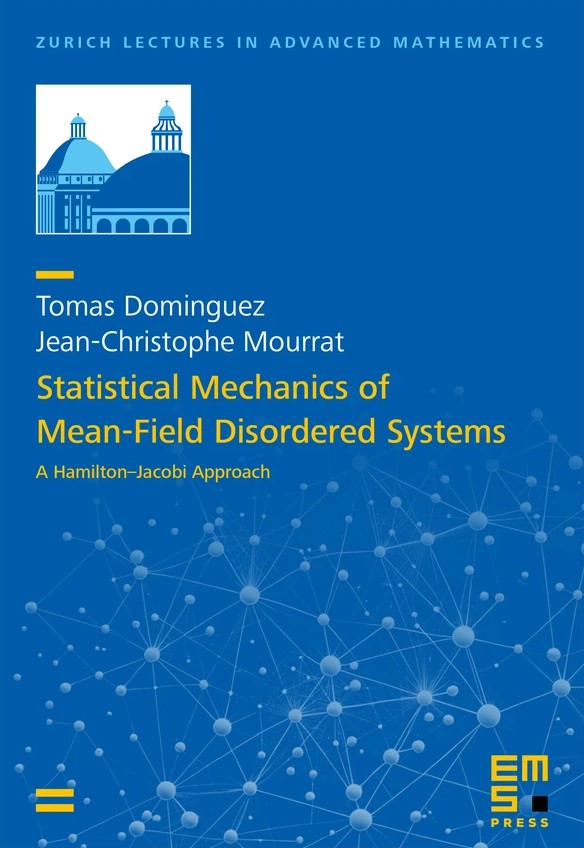
Tomas Dominguez and Jean-Christophe Mourrat, Statistical mechanics of mean-field disordered systems: A Hamilton–Jacobi approach. Zurich Lectures in Advanced Mathematics, EMS Press, 2024, vi+361 pages, Softcover ISBN 978-3-98547-074-7, eBook ISBN 978-3-98547-574-2.
Cite this article
Roland Bauerschmidt, Book review: “Statistical mechanics of mean-field disordered systems: A Hamilton–Jacobi approach” by Tomas Dominguez and Jean-Christophe Mourrat. Eur. Math. Soc. Mag. 139 (2026), pp. 52–53
DOI 10.4171/MAG/277