
This paper describes the failed attempts of the founder of modern set-theoretical topology, Felix Hausdorff, to save his life from the anti-Semitic Nazi threat by emigration to the United States in 1939. Although he was still mathematically productive, Hausdorff’s advanced age was his undoing, making him less attractive to the Americans. The paper is a translation of the 2021 German original [Mitt. Dtsch. Math.-Ver. 29 (2021), 132–136].
Introduction
It has often been discussed why the German Nazis, who came to power in 1933, “harmed themselves” and left so much scientific and cultural capital to America, in particular, through the mass expulsions. This negative side (“push”) of emigration has been partly explained by the fact that at that time, in the 1930s, the importance of basic sciences was still less visible worldwide. A second reason for the neglect of science by the Nazis was the priority of the ideology of anti-Semitism in the chauvinistic Nazi policy, which was aimed at preparing for war in the long term. On the other, positive side (“pull”), reference was made to the role of far-sighted foreign scientists (there were also short-sighted and xenophobic ones, even in the USA), who particularly supported the young and promising among the mostly Jewish immigrants, including mathematicians. However, it became clear that foreign countries set priorities early on, so that older scientists had poor chances of emigration from Germany and thus poor chances of survival. This was particularly true in the period after the outbreak of the war in Europe in September 1939, which led to increased political caution and isolation in all countries. Help that was given despite these difficult conditions often depended on individual humanistic acts in the host countries resisting bureaucratic limitations. In any case, we today have no reason to feel morally superior, especially not in view of the worldwide rise of nationalism since 1990 following the fall of the Iron Curtain and given the fact that thousands of refugees are drowning in the Mediterranean these days.
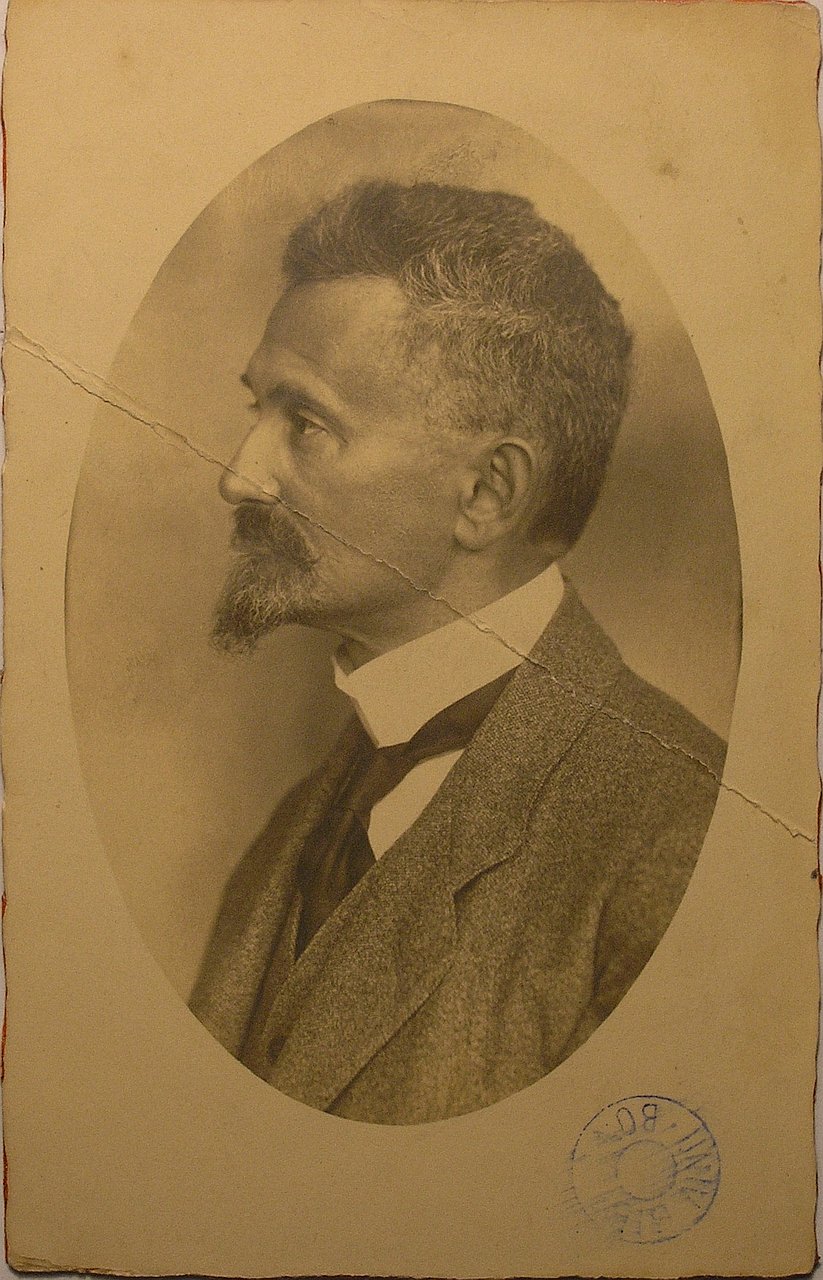
Felix Hausdorff (1868–1942). (© ULB Bonn: Portr.)
©© ULB Bonn: Portr.
The fate of Felix Hausdorff (1868–1942), one of the great pioneers of modern set-theoretical topology with his 1914 book Grundzüge der Mengenlehre, may serve us mathematicians as an illustration of the above remarks and remind us of our responsibility in the present.
Hausdorff after the Nazis came to power in 1933 and until the November pogrom of 1938
In 2021, just over a century and a half after Felix Hausdorff’s birth, the exemplary ten-volume German edition of Hausdorff’s ‘Collected Works’ [7 R. Siegmund-Schultze, Felix Hausdorff’s collected works – a meta-review. Historia Math. 60, 53–64 (2022) ] has come to a successful completion. Within this edition, an extensive biography appeared in 2018 as Volume IB. It runs to over a thousand pages, was written by the late Egbert Brieskorn and by Walter Purkert. A shortened version in English appeared in 2024 [2 E. Brieskorn and W. Purkert, Felix Hausdorff – mathematician, philosopher, man of letters. Vita Math. 21, Birkhäuser/Springer, Cham (2024) ]. In it, “Hausdorff’s life during the Nazi dictatorship” [2 E. Brieskorn and W. Purkert, Felix Hausdorff – mathematician, philosopher, man of letters. Vita Math. 21, Birkhäuser/Springer, Cham (2024) , pp. 415 ff.] is described as an example for the increasing disenfranchisement of Jewish academics after 1933 in material, as well as in general social and cultural terms. In the first years of the dictatorship, of course, Hausdorff had to bear his share of the public humiliation of German Jews, but his personal material situation was still satisfactory. At the beginning of 1935, at the age of 66, he was given emeritus status as part of a general Nazi law to streamline the administration [2 E. Brieskorn and W. Purkert, Felix Hausdorff – mathematician, philosopher, man of letters. Vita Math. 21, Birkhäuser/Springer, Cham (2024) , p. 422]. However, this put Hausdorff in a much better position than his colleague Otto Toeplitz in Bonn, for example, who was suspended in the autumn of the same year, at the age of 54, on the basis of the anti-Semitic “Nuremberg Laws.” When the Nazi administration announced in December 1935 that Hausdorff’s emeritus salary would be cut by around 50 per cent, they realized a few days later that this violated their own earlier laws, and they revoked this decision. The biographers report that Hausdorff was still active mathematically at the time and published seven more papers between 1933 and 1938, “all in Polish journals: six in Fundamenta Mathematicae and one in Studia Mathematica.” [2 E. Brieskorn and W. Purkert, Felix Hausdorff – mathematician, philosopher, man of letters. Vita Math. 21, Birkhäuser/Springer, Cham (2024) , p. 429]. One might add that these papers were essentially devoted to set-theoretical topics, in which these two journals specialised. Moreover, like Hausdorff’s works in general, these papers were all written in German. Hausdorff’s undiminished creative vigour in his later years is also evident from unpublished manuscripts from those years. His passable material situation, which was also secured by private assets, his attachment to the German language, and his close mathematical relationships with the Poles may explain why he did not try to leave Germany at the time. His biographers add:
Also his personal conviction – expressed in the presence of his daughter Nora – “that they probably won’t do anything to us old people,” helps to explain why Hausdorff made no attempt to emigrate during the years when that might still have been possible. He did not imagine, as few did at that time, that he and his family would witness a series of new decrees and orders, especially from 1939 onward, some of which directly affected Jewish emeriti and retired civil servants. The Nazi state passed these as part of its effort to oust Jews from economic life and gradually expropriate all Jewish property and wealth through “Aryanisation,” a process that accelerated after the November 1938 pogrom. [2 E. Brieskorn and W. Purkert, Felix Hausdorff – mathematician, philosopher, man of letters. Vita Math. 21, Birkhäuser/Springer, Cham (2024) , p. 424]
Hausdorff’s failed escape attempts
Indeed, the pogrom of November 9, 1938, often trivialised as “Reichskristallnacht,” changed everything. A series of new repressive measures against German Jews, often demagogically referred to as “protective custody” or “atonement,” was then initiated; Hausdorff was affected by the expropriation of a quarter of his saved assets, as were all his fellow Jewish citizens [2 E. Brieskorn and W. Purkert, Felix Hausdorff – mathematician, philosopher, man of letters. Vita Math. 21, Birkhäuser/Springer, Cham (2024) , p. 442]. In the months following the November pogrom, Hausdorff must have come to the conclusion that his life was in immediate danger and that only emigration could save him. The English language would not have been an insurmountable hurdle for the well-educated Hausdorff. He had already taken English lessons as a 25-year-old in 1893. Walter Purkert tells me in an email dated April 1, 2019:
English sometimes went through his mind quite easily: in 1932 or a little later he studied Menger’s book “Curve theory” very carefully and wrote down 132 sheets of notes on it (Nachlass, capsule 47, fascicle 985). He was particularly dissatisfied with Menger’s proof of the so-called Menger’s theorem in graph theory [n-Bogen-Satz]. He gave a much better proof in his manuscript; underneath he wrote [in English]: “That was a hard piece of work!” (sheet 116).
Hausdorff’s attempts to emigrate at the beginning of 1939 are documented indirectly from contemporary correspondence of mathematicians expelled from Germany to America.1The following quotations are taken from documents that I found during archival visits to the USA in the 1990s and which were published partly in the exhibition catalogue [1 B. Bergmann, M. Epple and R. Ungar (eds.), Transcending tradition: Jewish mathematicians in a German-speaking academic culture. [Catalogue to an exhibition] Springer, Berlin, Heidelberg (2012) ] and partly in the Hausdorff biography [2 E. Brieskorn and W. Purkert, Felix Hausdorff – mathematician, philosopher, man of letters. Vita Math. 21, Birkhäuser/Springer, Cham (2024) ] mentioned above.
On February 10, 1939, Richard Courant, the mathematician in New York who had been expelled from Göttingen, wrote a letter to Hausdorff in English. He had dictated the letter to his American secretary, and only a carbon copy has come down to us.2In the Courant Papers, New York University Archives. In it, Courant responds to an enquiry from Hausdorff dated January 31, 1939, which is not known to us in detail. Courant begins by saying: “Of course, every mathematician in the world is under a great obligation to you and I certainly always have felt this way.” However, he immediately dampens Hausdorff’s expectations:
However, the circle of my personal influence is extremely narrow and offhand I do not see within it any concrete possibility, but I have immediately communicated with Weyl hoping that through a certain connection he has, something can be done. [2 E. Brieskorn and W. Purkert, Felix Hausdorff – mathematician, philosopher, man of letters. Vita Math. 21, Birkhäuser/Springer, Cham (2024) , pp. 442–444] and [1 B. Bergmann, M. Epple and R. Ungar (eds.), Transcending tradition: Jewish mathematicians in a German-speaking academic culture. [Catalogue to an exhibition] Springer, Berlin, Heidelberg (2012) , p. 238]
Indeed, Hausdorff would hardly have been in a good place at Courant’s new institute at New York University, with its strongly applied and industry-orientated profile. One might initially assume that Courant’s allusion to Hermann Weyl refers to his position at the Institute for Advanced Study (IAS) in Princeton. Einstein and John von Neumann also worked there, pure mathematical and physical research was in the foreground, and there were no first-year students. In the 1930s, many emigrants received research fellowships at this institute, which enabled them to make a start in the American host country (R. Brauer, Siegel, Artin).3Emmy Noether gave special seminars at the Institute in 1934 and 1935, coming from her temporary position at Bryn Mawr College in Pennsylvania.
However, it is clear from a letter that Courant wrote to Weyl on the same day, February 10, 1939, that Courant regarded a scholarship for Hausdorff at the IAS as hopeless from the outset. The letter states, among other things:
I just received the enclosed short and very touching letter from Professor F. Hausdorff (which please return), who is seventy years old and whose wife is sixty-five years old. He certainly is a mathematician of very great merit and still quite active. He asks me whether it would be possible to find a research fellowship for him. I refer the matter to you because it may be that Shapley, with whom you are in touch, might conceivably be interested in the case.4R. Courant to H. Weyl, February 10, 1939. Veblen Papers, Library of Congress, cont. 31, f. Hausdorff.
Courant is referring here to the “Asylum Fellowship Plan” of the prominent astronomer at Harvard University, Harlow Shapley [3 B. Z. Jones, To the rescue of the learned: The asylum fellowship plan at Harvard, 1938–1940. Harv. Libr. Bull. 32, 205–238 (1984) ]. As the word “asylum” suggests, the aim here was to help older emigrants, in particular those who were no longer able to obtain regular academic positions. In contrast, fellowships at the IAS in Princeton were reserved for younger people. The mathematicians mentioned above were all considerably younger than Hausdorff. Even Einstein (born in 1879), one of the oldest at the institute, was eleven years younger.
Weyl seems to have responded immediately to Courant’s letter, together with his colleague at the IAS, John von Neumann. In the “Refugee Files” in the Shapley estate at Harvard University, there is a document dated February 17, 1939, with the heading “Felix Hausdorff,” where the following two expert opinions are quoted [2 E. Brieskorn and W. Purkert, Felix Hausdorff – mathematician, philosopher, man of letters. Vita Math. 21, Birkhäuser/Springer, Cham (2024) , p. 444]:
Hausdorff is known the world over as the author of the classical work on theory of sets in general, and point sets in particular. On this foundation set-theoretic topology has built ever since. Much of his research work is along the same lines. His other important papers are on such diverse subjects as Waring’s problem, bilinear forms of infinitely many variables, problem of momentum, astronomy, etc. In spite of his seventy years, he is still a creative mathematician.
A man with a universal intellectual outlook, and a person of great culture and charm.
H. Weyl
Hausdorff is a many-sided mathematician who has made contributions in widely varying fields, so that his activities even outside of his main field – set theory – would put him in a very respectable place among mathematicians. His contributions to set theory are of the very first order; especially concerning the foundations of topology, point-set topology, theory of analytic sets, theory of measure, etc. His book on set theory is probably the best ever written on the subject. In spite of his age, he still keeps up production of absolutely first quality. I feel that the mathematical community is under great obligation to him.
John von Neumann
All three, Courant, Weyl and von Neumann, thus emphasized in their statements that Hausdorff was still creative as a mathematician despite his age of 70.
Around the same time, there were other initiatives by mathematicians in Europe with the aim of helping Hausdorff. Weyl’s former colleague in Zürich, George Pólya, who himself distrusted the relative safety of Switzerland and a year later fled to America, wrote to Weyl from Zürich on May 29, 1939:
A case which is very near to me is . He had written a few lines first to Schwerdtfeger, then to me. From that anybody who knows him realizes that he is in a very bad situation. One hope that I had for him based on a communication by Toeplitz, and which I was incautious enough to relate to Hausdorff as well, has proved to be totally illusory. He is over 70 – and he is one of the nicest and most pleasant human beings I know – his direct and indirect students (through his book) are everywhere densely distributed [überall dicht verteilt]. Isn’t there a chance of doing something for him? [4 R. Siegmund-Schultze, Mathematicians fleeing from Nazi Germany: Individual fates and global impact. Princeton University Press, Princeton, NJ and Woodstock, UK (2009) , p. 97]
Another letter of support must have been written by Erich Bessel-Hagen in Bonn. This emerges indirectly from a postcard written to Bessel-Hagen on April 5, 1939 by Otto Neugebauer, the famous decipherer and interpreter of Babylonian mathematical and astronomical texts, who cooperated with Bessel-Hagen on historical issues [5 R. Siegmund-Schultze, “Not in possession of any Weltanschauung”: Otto Neugebauer’s flight from Nazi Germany and his search for objectivity in mathematics, in reviewing, and in history. In A mathematician’s journeys, Archimedes 45, Springer, Cham, 61–106 (2016) ]. Neugebauer, who had edited the Zentralblatt für Mathematik in Copenhagen as an émigré from 1934, had just emigrated to Providence in Rhode Island after the Zentralblatt crisis of November 1938. There he founded Mathematical Reviews in 1940. Bessel-Hagen, who (like Neugebauer) was not affected by the Nazi racial laws, was one of the few colleagues in Germany who remained in personal contact with Hausdorff, along with Toeplitz, who emigrated to Palestine in 1939.
In the postcard, which we reprint here in facsimile as in [5 R. Siegmund-Schultze, “Not in possession of any Weltanschauung”: Otto Neugebauer’s flight from Nazi Germany and his search for objectivity in mathematics, in reviewing, and in history. In A mathematician’s journeys, Archimedes 45, Springer, Cham, 61–106 (2016) , p. 94], Neugebauer reacted pessimistically to a presumed proposal by Bessel-Hagen:
How the theory of sets could be transformed is totally beyond me, I do not see the slightest chance. The universities here are traditionally commercial, and the president is responsible to the financial committee for his politics, particularly with respect to personnel. Therefore, each position has, in a way, to earn its own income, and as far as set theory is concerned, they have here plenty of affordable people, because the topic is very fashionable [modern] here.
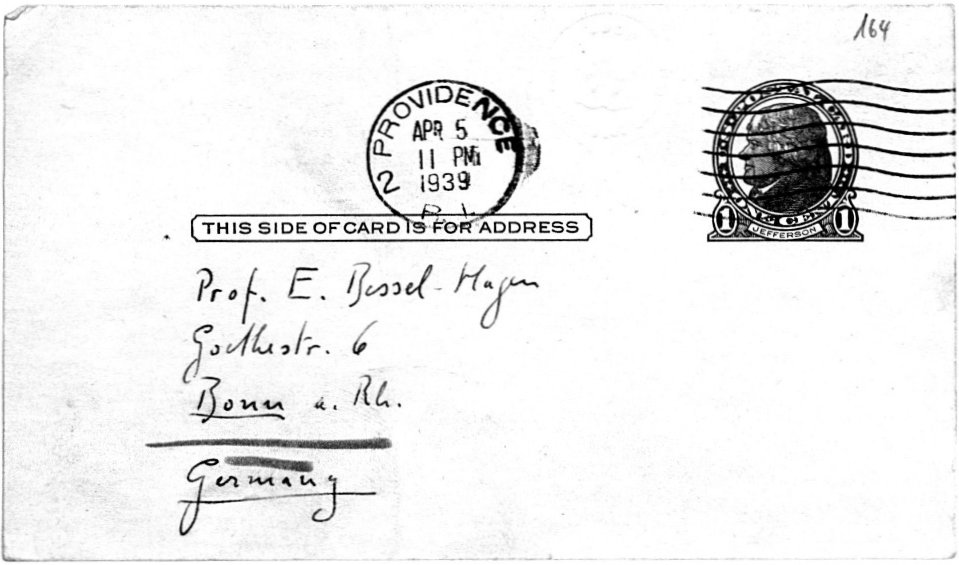
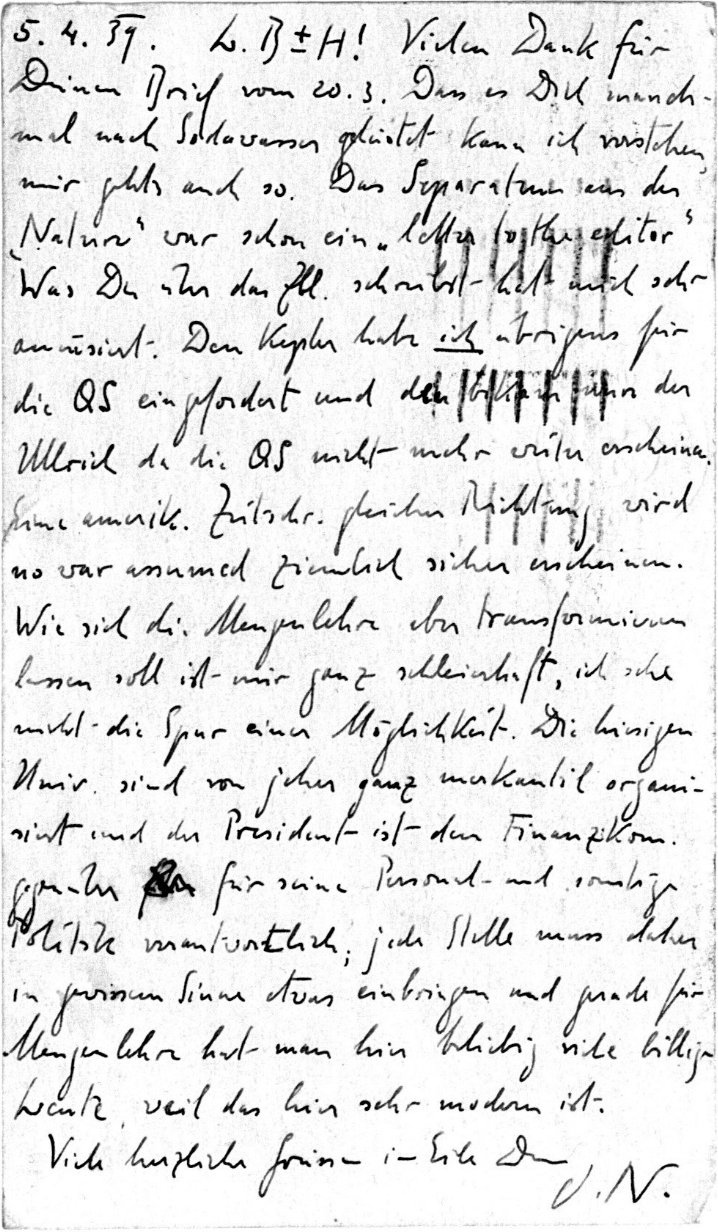
Postcard from Otto Neugebauer (Providence, RI) to Erich Bessel-Hagen (Bonn) April 5, 1939. (© ULB Bonn: NL Bessel-Hagen 053)
©© ULB Bonn: NL Bessel-Hagen 053
Given that Neugebauer had chosen to send an open postcard written in German to National Socialist Germany, the somewhat cryptic text is not surprising. In view of the efforts made at the same time in favour of Hausdorff as documented above, there can, in my opinion, be no doubt that “transformation of set theory” refers to a possible emigration of Hausdorff. On an earlier occasion Neugebauer and Courant had used the word “transformation” in a non-mathematical sense as part of a kind of secret political language. Courant had written the following to Neugebauer on September 12, 1933, apparently recommending that he emigrate to Copenhagen:
Generally Harald [Bohr] tends to emphasize the transformation theory instead of fixed point theorems. That method is also more rewarding for your work. [4 R. Siegmund-Schultze, Mathematicians fleeing from Nazi Germany: Individual fates and global impact. Princeton University Press, Princeton, NJ and Woodstock, UK (2009) , p. 162]
The head of Neugebauer’s mathematics department at Brown University in Providence was the influential secretary of the AMS, R. G. D. Richardson, who was often sceptical about the immigration of mathematicians. Thus, it is not surprising that Neugebauer, who had just arrived in Providence, saw no chance for Hausdorff.
A year after Neugebauer’s postcard to Bessel-Hagen, the same Richardson responded, on April 16, 1940, i.e., between the German occupation of Denmark and Norway and that of France, to a letter from the German immigrant and mathematical statistician Emil Julius Gumbel. Apparently, Richardson saw the invasion of France coming and supported a lecture tour in America by the elderly French-Jewish mathematician Jacques Hadamard (1865–1963), who had helped Gumbel with his first emigration to France. Richardson wrote to Gumbel:
While it is true that Brown University would be glad to welcome Professor Hadamard and pay him a small stipend if he were passing through, we recommend that he not be invited to come to this country, and I have said this to other persons. In his day, Hadamard was a great figure in mathematics, and he has visited this country and received a warm welcome, but he is now old and has not done anything significant in mathematics for a decade. There are persons in Europe whom the mathematicians of this country would much prefer to have come. [4 R. Siegmund-Schultze, Mathematicians fleeing from Nazi Germany: Individual fates and global impact. Princeton University Press, Princeton, NJ and Woodstock, UK (2009) , pp. 257–258]
Hadamard was three years older than Hausdorff. As a prominent Parisian mathematician, he was a “great figure,” as Richardson writes, and certainly better known among older and influential American mathematicians than Hausdorff from the small town of Bonn. Hadamard finally reached the USA after the occupation of his country, but he never got beyond a temporary position at Columbia University in New York and returned to Europe at the end of 1944. Emigrants in America such as Weyl used his example, and that of other older immigrants such as Felix Bernstein and Max Dehn, to discuss the particular problems of this age group, especially the lack of pensions for them in America [4 R. Siegmund-Schultze, Mathematicians fleeing from Nazi Germany: Individual fates and global impact. Princeton University Press, Princeton, NJ and Woodstock, UK (2009) , p. 258].
Hausdorff’s death
Although Hausdorff was mathematically still more productive than Hadamard at the time, this was apparently not enough to save him. One last document that testifies to an attempt to save him is a circular letter from Courant dated May 21, 1941, to American scientific institutions “To Whom it May Concern,” in which it is once again imploringly stated: “In spite of his age his presence would be an asset to any institution of higher learning.” [1 B. Bergmann, M. Epple and R. Ungar (eds.), Transcending tradition: Jewish mathematicians in a German-speaking academic culture. [Catalogue to an exhibition] Springer, Berlin, Heidelberg (2012) , p. 239]
Courant’s letter also says prophetically: “His name will for a long time to come be unforgotten.”
After the outbreak of war in Europe, however, both leaving Germany and travelling to countries of refuge became increasingly difficult, and the USA itself entered the war in December 1941.
Hausdorff’s suicide in the spring of 1942 together with his wife and sister-in-law shortly before deportation has been vividly described by Erwin Neuenschwander, Brieskorn and Purkert. His poignant farewell letter bears witness to critical self-reflection, consideration for others, and sarcasm even in view of death. In the letter, he writes about the announced first station of his deportation, Endenich near Bonn:
Even Endenich is still perhaps not [“nich”, for “nicht”] the end! [2 E. Brieskorn and W. Purkert, Felix Hausdorff – mathematician, philosopher, man of letters. Vita Math. 21, Birkhäuser/Springer, Cham (2024) , p. 408]
Translated by the author with help from DeepL and June Barrow-Green (London).
- 1
The following quotations are taken from documents that I found during archival visits to the USA in the 1990s and which were published partly in the exhibition catalogue [1 B. Bergmann, M. Epple and R. Ungar (eds.), Transcending tradition: Jewish mathematicians in a German-speaking academic culture. [Catalogue to an exhibition] Springer, Berlin, Heidelberg (2012) ] and partly in the Hausdorff biography [2 E. Brieskorn and W. Purkert, Felix Hausdorff – mathematician, philosopher, man of letters. Vita Math. 21, Birkhäuser/Springer, Cham (2024) ] mentioned above.
- 2
In the Courant Papers, New York University Archives.
- 3
Emmy Noether gave special seminars at the Institute in 1934 and 1935, coming from her temporary position at Bryn Mawr College in Pennsylvania.
- 4
R. Courant to H. Weyl, February 10, 1939. Veblen Papers, Library of Congress, cont. 31, f. Hausdorff.
References
- B. Bergmann, M. Epple and R. Ungar (eds.), Transcending tradition: Jewish mathematicians in a German-speaking academic culture. [Catalogue to an exhibition] Springer, Berlin, Heidelberg (2012)
- E. Brieskorn and W. Purkert, Felix Hausdorff – mathematician, philosopher, man of letters. Vita Math. 21, Birkhäuser/Springer, Cham (2024)
- B. Z. Jones, To the rescue of the learned: The asylum fellowship plan at Harvard, 1938–1940. Harv. Libr. Bull. 32, 205–238 (1984)
- R. Siegmund-Schultze, Mathematicians fleeing from Nazi Germany: Individual fates and global impact. Princeton University Press, Princeton, NJ and Woodstock, UK (2009)
- R. Siegmund-Schultze, “Not in possession of any Weltanschauung”: Otto Neugebauer’s flight from Nazi Germany and his search for objectivity in mathematics, in reviewing, and in history. In A mathematician’s journeys, Archimedes 45, Springer, Cham, 61–106 (2016)
- R. Siegmund-Schultze, Kein Überleben für einen älteren Mathematiker: Felix Hausdorffs gescheiterte Emigration und Tod. Mitt. Dtsch. Math.-Ver. 29, 132–136 (2021)
- R. Siegmund-Schultze, Felix Hausdorff’s collected works – a meta-review. Historia Math. 60, 53–64 (2022)
Cite this article
Reinhard Siegmund-Schultze, No survival for an elderly mathematician: Felix Hausdorff’s failed emigration and death. Eur. Math. Soc. Mag. 136 (2025), pp. 11–15
DOI 10.4171/MAG/258